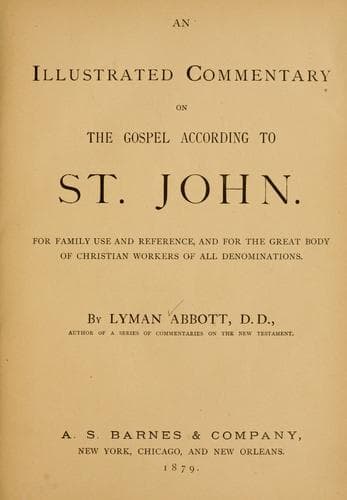
An illustrated commentary on the Gospel according to St. JohnAbbott, Lyman
Religion
An illustrated commentary on the Gospel according to St. John
Abbott, Lyman
Bible. John -- Commentaries
=6. This they said tempting him.= The commentators have been needlessly
puzzled to explain how Christ’s answer to this question could have
furnished matter for accusation. The Pharisees would have accused him
to the people, not to the Roman government. The law of Moses was a dead
letter. There is no authentic instance in post-Mosaic history of an
execution under it. Divorce was easy, and the injured husband generally
avoided public disgrace by simply separating from his unfaithful wife.
Could Christ refuse to adjudge the case? He had claimed to be King of
Israel, in the Sermon on the Mount, had put his own precepts above
those of Moses, and had proclaimed a far more stringent law of purity
than Moses ever enacted (Matt. 5:27-32). Could he acquit her,
and so set aside the Mosaic law? He had declared that not one jot or
tittle of it should pass away till all was fulfilled, and that whoever
relaxed the least of its precepts should be least in his kingdom. Could
he condemn her? He would thus revive an obsolete statute, and enforce
it against a hapless and defenceless woman--he who had come to seek
and to save the lost, who had received the publican and harlot among
his disciples, and had accepted the homage of a notorious woman of the
town (Luke 7:36-39). It often happens that people are unwilling
to have a teacher set aside in theory a law which they are equally
unwilling to see enforced in practice. Only a small minority is willing
in our own day to abolish capital punishment; but only rarely is a
jury willing to inflict it. There are comparatively few persons who
are willing to live according to the Sabbath law which they wish their
minister to preach.--=But Jesus stooped down and with his finger wrote
on the ground.= The words _as though he heard them not_ are an addition
of the translators, though at least one manuscript contains the
idea. What was the meaning of this action? Various opinions have been
suggested, _e. g._, a usual act signifying preoccupation of mind
(_Alford_); to hide his own confusion, the shock to his own moral
sensibility by the grossness of the Pharisees’ public abuse of the
woman (_Geikie_); as a judge, for a judicial sentence is not only
pronounced, but written (_Godet_); as a refusal to interfere, a sign
that he paid no attention to their question (_Meyer_, _Luthardt_).
His object in this writing seems to me to be interpreted by its
result. It turned all eyes from the wretched woman, in an anguish of
shame and terror, to himself. She stood alone and forgotten; all eyes
were then and have ever since been fixed on the figure of Christ,
wondering what and why he wrote in the dust. It is not fanciful to
note the contrast between this writing and that prescribed in case
of the trial of a suspected adulteress by the Mosaic law (Numb.
5:23). The priest was to write certain curses in a book, then
wash them with bitter water, which the accused was required to drink,
that the curses might enter into her if she were guilty.
Public-domain text, read in full here on John Shaqi.
Reviews
Reviews
No reviews yet
Be the first to share your thoughts on this work.
Elsewhere in the archive
Join the Discussion
Join the discussion
Sign in to leave a comment or review.
Sign InorCreate an account