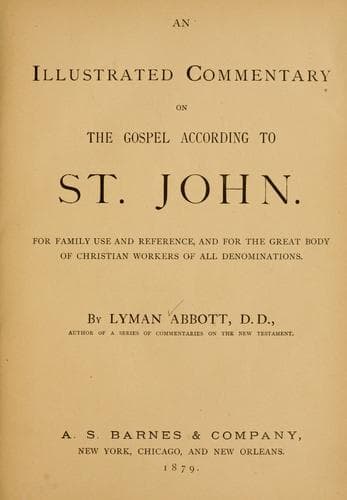
An illustrated commentary on the Gospel according to St. JohnAbbott, Lyman
Religion
An illustrated commentary on the Gospel according to St. John
Abbott, Lyman
Bible. John -- Commentaries
Christ, on
the contrary, writes his sentence on the sand, where, in a moment,
it will be effaced by the pardon, “Neither do I condemn thee; go,
and sin no more.” What he wrote has been made a matter of ingenious
rather than profitable conjecture. The most probable conjecture is that
he wrote the sentence, “He that is without sin amongst you,” etc.,
thus enabling the Pharisees, if they had not been too passionately
intent on their design, to avoid his public rebuke.
7 So when they continued asking him, he lifted up himself,
and said unto them, He that is without sin among you,[306]
let him first cast a stone at her.
[306] Deut. 17:7; Rom. 2:1, 22.
8 And again he stooped down, and wrote on the ground.
9 And they which heard _it_, being convicted by _their own_
conscience, went out one by one, beginning at the eldest,
_even_ unto the last: and Jesus was left alone, and the
woman standing in the midst.
=7-9. So when they continued asking.= They would not take the rebuke
of his quiet contempt. Had they stopped to think, conscience would
have answered their inquiry; but they were too eager; they did not
hear what it had to say to them; Christ must interpret its voice; and
he did so with a poignant rebuke.--=He that is without sin among you,
let him first cast a stone at her.= Christ puts on them the problem
with which they had sought to perplex him. In their vindictive haste
they had forgotten the provision of the law that the witnesses on
whose testimony the accused was condemned should cast the first stone
(Deut. 17:5-7). They had also forgotten the provision of the
Rabbinical law that, in case of accusation, if the husband was not
guiltless, the wife could not be condemned (_Lightfoot_). Christ
recalls these two principles, and leaves them to solve their own
problem. Go on, he says in effect, and try and condemn the accused
according to your own law. Let the sinless cast the first stone. But a
deeper meaning is in his words. Unchastity was a universal sin in the
first century. Its extent in Palestine is illustrated by the
licentious lives of the Herods, father and sons. Nowhere was this vice
more flagrant and unrestrained than among the priests, whose
licentiousness was no secret to the common people (see Matt. 12:39;
James 4:4). It was this revelation of their own guilt, implied in the
words and easily understood by the people, which stung them, and drove
them, self-condemned, one by one, from the presence of both the
accused and the judge.--=And again he stooped down.= To give
conscience in them an opportunity to assert itself, with as little
resistance as possible from pride. He gave them no opportunity to
answer; he did not look to see who was first to withdraw.--=Beginning
with the elders.= The word rendered eldest (πρεσβυτέρων) is almost
universally rendered _elders_, generally as an official designation,
and frequently in connection with the word _ruler_ (_e. g._, Matt.
Public-domain text, read in full here on John Shaqi.
Reviews
Reviews
No reviews yet
Be the first to share your thoughts on this work.
Elsewhere in the archive
Join the Discussion
Join the discussion
Sign in to leave a comment or review.
Sign InorCreate an account