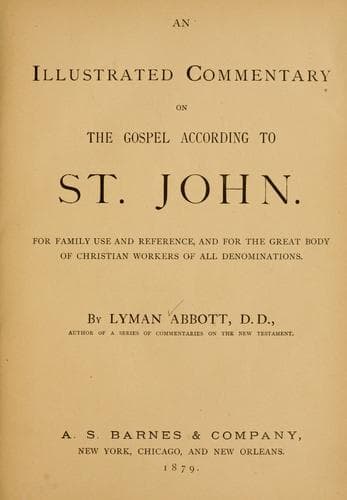
An illustrated commentary on the Gospel according to St. JohnAbbott, Lyman
Religion
An illustrated commentary on the Gospel according to St. John
Abbott, Lyman
Bible. John -- Commentaries
=17-20. Also in your own law.= Not in _our_ law; Christ never classes
himself with the Jews, nor counts himself as under their law. He obeys
it, not because it is binding, but by a voluntary subjection, for
example’s sake (Matt. 3:15; 17:27). The reference here is to Deut.
17:6; 19:15.--=I am one that bear witness concerning myself.= Not
merely nor mainly by words; for Christ said comparatively little in
public concerning his character; but by his life and works. See John
14:11.--=And the Father that sent me beareth witness of me.= By direct
declarations to his divine character and mission (Matt. 3:17; John
12:28); by the testimony of prophets and apostles, especially of John
the Baptist (Luke 2:28-32, 38; John 1:32-34, 36); by the voice of
angels (Luke 2:9-14); by the miracles wrought (John 11:42); but still
more by that manifestation of the divine presence which made itself
felt in many ways in Christ’s person, as in his attraction of
publicans and sinners to himself, his expulsion of the traders from
the temple, his passing through the mob at Nazareth, etc. Godet tells
a story in illustration of the power of this witness of the Spirit.
About 1660, Hedinger, chaplain to the Duke of Wurtemberg, took the
liberty of censuring his sovereign, at first in private, but afterward
in public, for a serious fault. The latter, much enraged, sent for
him, resolved to punish him. Hedinger, after seeking strength by
prayer, repaired to the prince, the expression of his countenance
betokening the peace and the presence of God. The prince, after
looking at him for a moment, asked, in agitation, “Why did you not
come alone?” and dismissed him unharmed. The vital communion of this
servant of God with his God was a sensible fact, even to one whom
anger had exasperated. Comp. Acts 4:13; 6:15.--=Who is your Father?=
Asked, not in perplexity, for Christ’s reference to God as his
Father had been so frequent at Jerusalem that they could not have
misunderstood his meaning, but in scorn. Christ’s reply is adapted to
the spirit of their inquiry.--=Ye neither know me nor my Father.= They
gloried in being the peculiar people of God; but they as little
apprehended him as they did Christ his Son.--=If ye had known me ye
would have known my Father also.= For the Son is the way to the
Father. The converse of this proposition is also true, He that knows
the Father will know the Son. Both are known by the spiritual
sense; and the same faculty which appreciates the divine qualities
resplendent in the Son will answer to and be ready to receive and be
impressed by the divine qualities in the invisible Spirit, the Father
whom no one hath seen or can see.--=In the treasury.= See Luke 21:1,
note. The thirteen trunks or chests placed for the reception of the
gifts of the worshippers, and properly called the treasury, were in
the Court of the Women. Each bore an inscription, indicating the use
to which the money placed therein was devoted. Probably either that
Public-domain text, read in full here on John Shaqi.
Reviews
Reviews
No reviews yet
Be the first to share your thoughts on this work.
Elsewhere in the archive
Join the Discussion
Join the discussion
Sign in to leave a comment or review.
Sign InorCreate an account