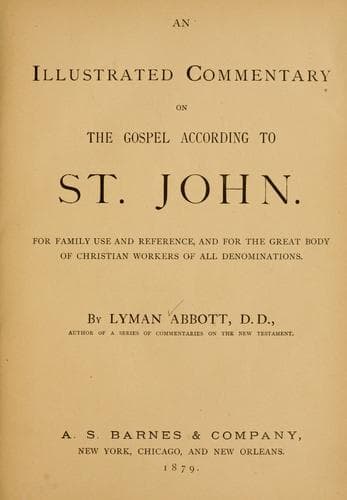
An illustrated commentary on the Gospel according to St. JohnAbbott, Lyman
Religion
An illustrated commentary on the Gospel according to St. John
Abbott, Lyman
Bible. John -- Commentaries
=25. Who art thou?= A question asked possibly partly in perplexity and
partly in scorn, but more for the purpose of evoking an answer which
would give them a point for an attack upon Christ.--=Even the same that
I said unto you from the beginning.= The grammatical difficulties in
the correct rendition of this passage are almost insuperable, and no
two scholars give exactly the same shade of meaning to it, while none
of the interpretations afforded are altogether satisfactory, even to
the interpreter. The principal interpretations are: (1) _What I from
the beginning am teaching you? do you ask that?_ An interrogative
expression of surprise. According to this view Christ does not answer
the question at all. (2) _Why indeed do I still speak to you at all?_ A
language of reproach. (3) _Even the same that I said unto you from the
beginning_, the rendering of our English version. (4) _Essentially that
which also I discourse to you_; _i. e._, You are to ascertain my nature
by a study of my discourses. Neither one of these interpretations, it
will be seen, affords a direct answer to the question.
26 I have many things to say and to judge of you: but[327]
he that sent me is true; and I speak to the world those
things which I have heard of him.
[327] ch. 7:28.
27 They understood not that he spake to them of the Father.
=26, 27. Many things I have which I might say, and many sentences
which I might pronounce concerning you.= The meaning and the
connection is obscure, and the translation which I have given is not
so literal as that of the English version. But Christ elsewhere
declares that he has not come to judge the world (ver. 15; chaps.
3:17; 12:47), and to understand him here to assert the contrary makes
his utterances contradictory. Moreover, if we interpret his
declaration as the English version does, it is difficult to see any
connection with the preceding or the subsequent clause. I understand
therefore that he means that he _has_ many things to say, and many
judgments formed in his own mind, which he might pronounce, but that
he will only speak those things which he has been commissioned by the
Father to speak; and his commission at this time is not to judge, but
to save the world.--=They understood not that he spake to them of the
Father.= Strange! Less strange, perhaps, than it now seems to us, for
we read this discourse in the light of eighteen centuries of
Christianity. So far, too, Christ had not designated by any title the
One who had sent him. He had veiled his meaning, as he did in the
parables, that he might not be fully understood at once; for he could
hope to get lodgment for the truth only by gradually unfolding it.
“There is no accounting for the _ignorance of unbelief_ as any
minister of Christ knows by painful experience.”--(_Alford._)
Public-domain text, read in full here on John Shaqi.
Reviews
Reviews
No reviews yet
Be the first to share your thoughts on this work.
Elsewhere in the archive
Join the Discussion
Join the discussion
Sign in to leave a comment or review.
Sign InorCreate an account