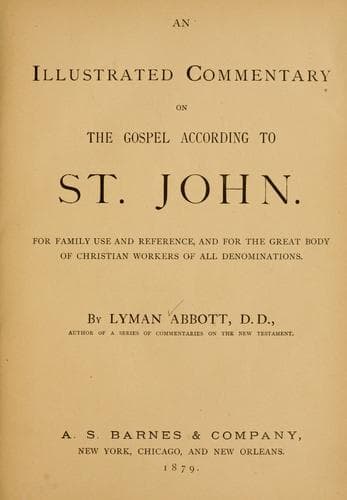
An illustrated commentary on the Gospel according to St. JohnAbbott, Lyman
Religion
An illustrated commentary on the Gospel according to St. John
Abbott, Lyman
Bible. John -- Commentaries
28 Then said Jesus unto them, When ye have lifted up[328]
the Son of man, then shall ye know that I am _he_, and
_that_ I do nothing of myself; but as my Father hath taught
me, I speak these things.
[328] chaps. 3:14; 12:32.
29 And he that sent me is with me: the Father hath not left
me alone; for I do always those things that please him.
30 As he spake these words, many[329] believed on him.
[329] ch. 10:42.
=28-30. When ye have lifted up the Son of man.= The phrase Son of man
was used by the rabbis, who borrowed it from David, for the Messiah
(see Matt. 10:23, note). The Greek verb here rendered _lifted up_
(ὑψόω) is used by John only with reference to the crucifixion (chaps.
3:14; 8:28; 12:32, 34), but everywhere else in the N. T. is used in
the sense of _exalted_, and is so translated except in James 4:10. See
Matt. 11:23; Luke 1:52; Acts 2:33; 5:31, etc. This fact is of itself
an indication that John’s Gospel was written after the cross had been
seen to be the means by which Christ was himself exalted, his glory,
not his shame. It is the cross which has led to his recognition among
men as the Son of God (Mark 15:39; 1 Cor. 1:23, 24); to his exaltation
by the Father (Phil. 2:8-10); to his adoration in heaven (Rev.
5:12).--=Ye shall know that I am.= See on ver. 24. The passion and
death of Christ is the attestation of his divinity (Mark 15:39).--=I
do nothing of myself; but as the Father hath taught me I speak these
things.= In Christ’s time the things _done_, _i. e._, the miracles,
were recognized as signs of divine presence and power; more and more
the _words spoken_ are recognized as still greater signs of the divine
presence and power. The word is more than the external work, the truth
is greater than the miracle.--=He that sent me is with me.= The Son is
a manifestation of the Father, because the Father is ever in and
working and speaking through the Son. He is not merely an ambassador
sent by, he is a tabernacle in which dwells, the Eternal King. So
Christ, who sends forth his disciples (ch. 17:18), is ever with them
(ch. 14:17, 23; Matt. 28:20).--=The Father hath not left me alone; for
I do those things that please him always.= _Always_ is emphatic. In
this uniformity of obedience to the Father’s will is the secret of the
abiding of his presence; it is true for us, as for Christ, that doing
the Father’s pleasure secures the divine fellowship (chaps. 14:21;
15:10).--=Many believed on him.= Comp. ch. 12:42. Faith, like
knowledge, is of different degrees, and the quality of this faith is
not indicated. It may have been like the seed received on stony places
(Matt. 13:20, 21). But beware of understanding here, or anywhere, by
this phrase a mere intellectual belief in Christ as either Rabbi,
Prophet, or Messiah. To _believe on_ always signifies an emotion or
heart action. “Our Lord’s words did not appeal to the understanding;
Public-domain text, read in full here on John Shaqi.
Reviews
Reviews
No reviews yet
Be the first to share your thoughts on this work.
Elsewhere in the archive
Join the Discussion
Join the discussion
Sign in to leave a comment or review.
Sign InorCreate an account