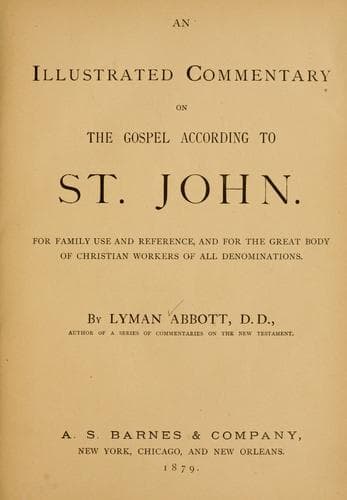
An illustrated commentary on the Gospel according to St. JohnAbbott, Lyman
Religion
An illustrated commentary on the Gospel according to St. John
Abbott, Lyman
Bible. John -- Commentaries
=41, 42. Ye do the deeds of your father.= A generic truth; the
spiritual paternity of any soul may be known by its deeds; the
source of its life is witnessed by the life itself.--=We be not
born of fornication.= It is a Jewish legend to this day that
Jesus was born of adultery. This is the Jewish explanation of his
premarital birth. I believe that this legend had been invented in
Christ’s own time to account for his supernatural birth, and that
the expression here is a scornful allusion to this dishonoring
report. This, at least, though I do not find it suggested by any
of the commentaries, seems to me the most natural explanation of
the language of the Pharisees, which has given the scholars
no little difficulty. Other explanations suggested--_e. g._, that Sarah
was not an adulteress, and therefore the Jews were certainly children
of Abraham (_Meyer_), or that, unlike the Samaritans, there was no
taint of heathen blood in their veins (_Alford_, _Godet_)--seem to me
unnatural and far-fetched, and are apparently not very satisfactory
even to those who suggest them.--=We have one Father, even God.= They
abandon their claim to have derived their life from Abraham, and
substitute a claim to derive it from the God of Abraham. Or we may
suppose that, the first interlocutors being silenced, others make this
assertion.--=If God were your Father ye would love me.= The practical
and present application is that every soul whose life is truly rooted
in God will be drawn toward Christ by spiritual sympathy.--=For I came
forth and am here from God.= The first verb (ἐξῆλθον) indicates
Christ’s _coming forth_ from the glory which Christ had with the
Father from the beginning of the world (John 17:5); the second verb
(ἥκω, present formed from a perfect) indicates the _perpetual
presence_ of the Father with Christ, and Christ’s continuous
manifestation of the Father to the world.--=Neither came I of myself.=
Therefore that phase of theology which represents the Son as
interceding to make a just God merciful, and thus induce him to
forgive the sinful, is thoroughly false. The mercy of Christ
originated with the Father; the mission of Christ was wrought out by
the Father. Christ came not of his own will, but of the Father’s. See
chaps. 3:16, note; 6:38, note.
43 Why do ye not understand my speech? _even_ because ye
cannot hear my[345] word.
[345] Isa. 6:9.
44 Ye[346] are of _your_ father the devil, and the lusts
of your father ye will do. He was a murderer from the
beginning, and abode[347] not in the truth, because there
is no truth in him. When he speaketh a lie, he speaketh of
his own: for he is a liar, and the father of it.
[346] Matt. 13:38; 1 John 3:8.
[347] Jude 6.
Public-domain text, read in full here on John Shaqi.
Reviews
Reviews
No reviews yet
Be the first to share your thoughts on this work.
Elsewhere in the archive
Join the Discussion
Join the discussion
Sign in to leave a comment or review.
Sign InorCreate an account