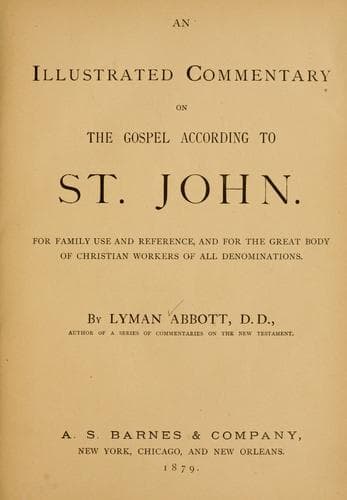
An illustrated commentary on the Gospel according to St. JohnAbbott, Lyman
Religion
An illustrated commentary on the Gospel according to St. John
Abbott, Lyman
Bible. John -- Commentaries
48 Then answered the Jews, and said unto him, Say we not
well that thou art a Samaritan, and[350] hast a devil?
[350] ch. 7:20.
49 Jesus answered, I have not a devil; but I honour my
Father, and ye do dishonour me.
50 And I[351] seek not mine own glory: there is one that
seeketh and judgeth.
[351] ch. 5:41.
=48-50. Say we not well thou art a Samaritan and hast an evil
spirit?= The Jews take to the common resort of men silenced
and convinced against their will; they reply to argument
by calling names. _Devil_ is an unfortunate translation, giving the
English reader the impression that they use the same word which Christ
has used in ver. 44. Their word is _demon_ (δαιμόνιον), and signifies
primarily, in classic usage, a tutelary demon or genius; in N. T.
usage, an evil spirit. These spirits are represented as fallen angels
(2 Pet. 2:4; Jude 6), subject to Satan (Matt. 9:34; 25:41;
2 Cor. 12:7; Rev. 12:9), possessing the power of working miracles
(Rev. 16:14), dwelling in the idols of the heathen and uttering
the heathen responses and oracles (Acts 16:17; 1 Cor. 10:20; Rev.
9:20), and the authors of evil to mankind (2 Cor. 12:7; 1 Tim.
4:1). See _Rob. Lex._, art. δαιμόνιον. The charge had before
been made by the Pharisees that Christ cast out devils by Beelzebub
the prince of devils (Matt. 12:24). It is not necessary to trace any
connection between the two epithets _a Samaritan_ and _possessing a
demon_. Passion is never coherent. The language is wild, bitter,
passionate, but illogical and inconsequential.--=I have not a devil *
* * * ye do dishonor me.= He passes by the charge of being a Samaritan
in silence, for the author of the parable of the Good Samaritan
refuses to recognize opprobrium in it; he calmly denies the charge of
having a demon, and declares that by the discourses which they
attribute to a demon he honors the Father, while they dishonor him.
Peter’s declaration (1 Pet. 2:23), “Who, when he was reviled, reviled
not again, but committed himself to him that judgeth righteously,” is
illustrated by Christ’s response here. Contrast his indignation at the
wrong done to others (Matt. 23:14, 15, 23, etc.) with his mildness
when wrong is done to himself. And the next verse gives the secret
reason of his calmness.--=I am not seeking my own glory.= Therefore he
is comparatively indifferent to public abuse and dishonor.--=There is
one who seeks and judges.= Because God cares for the honor of his
children, they can well be unconcerned respecting it; because God
judges them righteously, they can well disregard the unrighteous
judgments of men.
51 Verily, verily, I say unto you, If a man keep my saying,
he shall never see death.
Public-domain text, read in full here on John Shaqi.
Reviews
Reviews
No reviews yet
Be the first to share your thoughts on this work.
Elsewhere in the archive
Join the Discussion
Join the discussion
Sign in to leave a comment or review.
Sign InorCreate an account