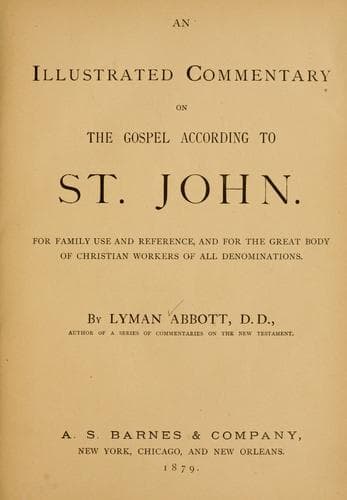
An illustrated commentary on the Gospel according to St. JohnAbbott, Lyman
Religion
An illustrated commentary on the Gospel according to St. John
Abbott, Lyman
Bible. John -- Commentaries
=51. Verily, verily.= With Calvin and Godet, I regard Christ’s
discourse to his opponents as ended with the preceding verse.
Recognizing the fact that some of his auditors have been inclined
toward him, though with but a feeble faith, he addresses them in the
words that follow, that he may strengthen their faith. The connection
which Alford and Meyer endeavor to trace between this and the
preceding verse I cannot perceive: _e. g._, “Ye are now the children
of the devil; but if ye keep my word ye shall be rescued from that
murderer.”--(_Alford._) The very words with which Christ begins the
sentence, “Verily, verily” (ἀμὴν, ἀμὴν) indicate a new topic.--=If any
one.= Emphasis is put on the pronoun. The promise is universal; it
embraces Jew and Gentile.--=Keep my word.= _Keep_, as a guard his
prisoner, with watchfulness (Matt. 19:17, note), against all
seductions and assaults; _Christ’s word_, that which he had taught,
and therefore pre-eminently that faith in him as a divine Saviour
which had been the pre-eminent theme of his teaching. We are to keep
not merely the _sayings_ in _memory_, or the _teaching_ in the
_heart_, but, with sentiments of reverence and affection, the _truth_
in our _life_, both in the inward experience and in the outward
conduct.--=Shall not see death for ever.= Not, _Shall not see eternal
death_, but, _Shall never see death_. “The death of the body is not
reckoned as death, any more than the life of the body is life, in our
Lord’s discourses. See ch. 11:25, 26.”--(_Alford._) Christ puts
himself in contrast with the devil, whose slaves, by evil-doing, the
Jews have become (ver. 34). The devil is a murderer, a life-taker
(ver. 44); Christ is a life-giver, even to those that are dead in
trespasses and sins (Ephes. 2:1).
52 Then said the Jews unto him, Now we know that thou hast
a devil. Abraham is dead,[352] and the prophets; and thou
sayest, If a man keep my saying, he shall never taste of
death.
[352] Zech. 1:5.
53 Art thou greater than our father Abraham, which is dead?
and the prophets are dead: whom makest thou thyself?
Public-domain text, read in full here on John Shaqi.
Reviews
Reviews
No reviews yet
Be the first to share your thoughts on this work.
Elsewhere in the archive
Join the Discussion
Join the discussion
Sign in to leave a comment or review.
Sign InorCreate an account