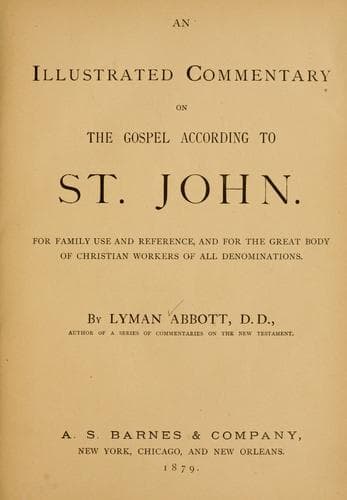
An illustrated commentary on the Gospel according to St. JohnAbbott, Lyman
Religion
An illustrated commentary on the Gospel according to St. John
Abbott, Lyman
Bible. John -- Commentaries
=52, 53. The Judeans.= Not the believers of ver. 30. The opponents of
Christ reply to words which were not addressed to them.--=Abraham is
dead.= * * * * --=Art thou greater than our father Abraham?= * * *
=Whom makest thou thyself?= Their argument is, as Chrysostom
interprets it: “They who have heard the word of God are dead, and
shall they who have heard thee not die?” Their perplexity was real,
for the unspiritual never comprehend either spiritual natures or
spiritual teaching. They are literalists, and understand Jesus to
speak of natural death. They are dull and will not comprehend his
declaration that he is the Messiah in hope of whom Abraham and the
prophets had lived. Compare with their question here that of the
Samaritan woman (ch. 4:12), “Art thou greater than our father Jacob?”
but contrast their spirit with hers. She is in doubt; they are
scornful. See also Christ’s declaration in Matt. 12:42, “Behold, a
greater than Solomon is here.”
54 Jesus answered, If[353] I honour myself, my honour is
nothing: it is my Father[354] that honoureth me; of whom ye
say, that he is your God:
[353] ch. 5:31, 41.
[354] ch. 17:1.
55 Yet ye have not known him; but I know him: and if I
should say, I know him not, I shall be a liar like unto
you: but I know him, and keep his saying.
56 Your father Abraham rejoiced to see my day: and he[355]
saw _it_, and was glad.
[355] Gen. 22:13, 14; Heb. 11:13.
=54-56. If I glorify myself my glory is nothing.= To _honor_ or
_glorify_ (δοξάζω) is to attribute honor, generally by words. Christ’s
reply to the question, _Whom makest thou thyself?_ is that he makes
nothing of himself; he leaves others to interpret his character from
his life and teachings. And this is singularly true; Christ is to each
soul what its spiritual sight is able to discern in him. He does not
declare himself.--=It is my Father that glorifieth me.= He leaves his
reputation in the hands of his Father, an example to his followers
when belied and misrepresented. See on ver. 18.--=Ye have never
learned him, but I know him.= There is a double contrast in the two
verbs (γινώσκω and οἶδα), the one signifying acquired, the other
direct intuitive knowledge; and in the tenses, the one signifying a
past act, _never have known_, the other a perpetually present
possession, _I always know_. The sense may be expressed: _Ye have
never acquired any knowledge of God, but I am always in fellowship
with him._--=I should be a liar like unto you.= To boast of one’s
spiritual experience is to glorify one’s self; such glory is nothing.
To deny it, under pretence of humility, is to become a liar. There may
be hypocrisy in disavowing the sense of God’s presence and love, as
well as in falsely pretending to it. The true method is that of
Christ, who showed it by his life, not by his professions.--=Your
father Abraham exulted that he might see my day= (_i. e._, that it was
Public-domain text, read in full here on John Shaqi.
Reviews
Reviews
No reviews yet
Be the first to share your thoughts on this work.
Elsewhere in the archive
Join the Discussion
Join the discussion
Sign in to leave a comment or review.
Sign InorCreate an account