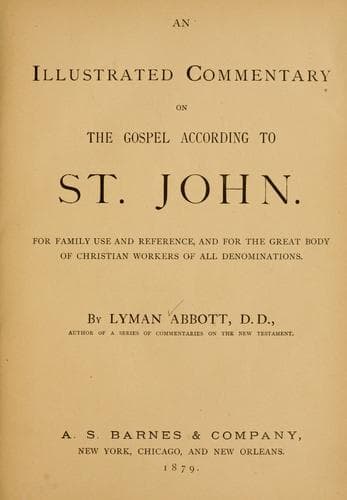
An illustrated commentary on the Gospel according to St. JohnAbbott, Lyman
Religion
An illustrated commentary on the Gospel according to St. John
Abbott, Lyman
Bible. John -- Commentaries
PRELIMINARY NOTE.--This miracle is reported only by John. There is
nothing peculiar in this, since John alone reports Christ’s Judean
ministry, in which it occurred. The place was Jerusalem; the time is
uncertain; it was on a Sabbath (ver. 14), in the fall of A. D. 29
(Vol. I, p. 45), between the feast of Tabernacles in October (ch. 7:2)
and the feast of Dedication in December (ch. 10:22). Some identify it
with the last day of the former feast (ch. 7:37), which was a Sabbath,
supposing ch. 7:53 to 8:11 to be an interpolation. It is not probable
that it occurred at the time which seems to be indicated by its place
in the report furnished by the Evangelists. That Christ stopped on
escaping from a mob who threatened to stone him, in order to work this
miracle, is not probable; that under such circumstances his disciples
should have asked him the abstruse question of ver. 2 is still more
improbable. I put it therefore at some other time in his Judean
ministry, which lasted a little over two months. See ch. 7, Prel.
Note. In studying this chapter the student will do well to observe its
natural division into three parts: (1) the miracle (verses 1-7); (2)
the investigation (verses 8-33); (3) the result (verses 34-38).
1 And as _Jesus_ passed by, he saw a man which was blind
from _his_ birth.
=1. And passing by, he saw a man blind from birth.= To the ordinary
reader the connection of this verse with the last verse of the
preceding chapter indicates that this miracle was wrought as Jesus
passed from the temple driven by the mob. But the latter clause of
that verse is of doubtful authenticity. The phrase “passing by”
appears to be used here simply to indicate that the miracle of mercy
was called forth by the occasion, not by the blind man’s petition nor
by any previously formed purpose. “It was he who saw the blind man,
not the blind man who came to him; and so earnestly did he look upon
him that even his disciples perceived it.”--(_Chrysostom._) Compare
this case with that in Luke 18:35-43. There the blind man appeals to
Christ, here Christ heals without being appealed to. There, in the
stillness of the country, the noise of the multitude awakens the
attention of the blind man. Here, in the crowded city, there is
nothing to announce to the blind man a healer until Christ speaks to
him. There, therefore, he awaits the petition; here he does not.
Congenital blindness is incurable by modern science. How it was known
to the Evangelist that this man was blind from his birth has been
questioned. The man appears, from the following narrative, to have
been a well-known mendicant. Perhaps he proclaimed the nature and
extent of his misfortune as a means of awakening charity.
2 And his disciples asked him, saying, Master, who did sin,
this man, or his parents, that he was born blind?
Public-domain text, read in full here on John Shaqi.
Reviews
Reviews
No reviews yet
Be the first to share your thoughts on this work.
Elsewhere in the archive
Join the Discussion
Join the discussion
Sign in to leave a comment or review.
Sign InorCreate an account