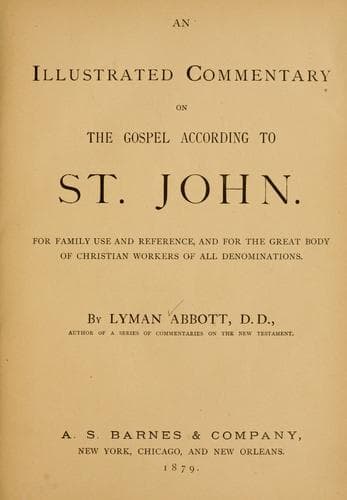
An illustrated commentary on the Gospel according to St. JohnAbbott, Lyman
Religion
An illustrated commentary on the Gospel according to St. John
Abbott, Lyman
Bible. John -- Commentaries
=2. Who did sin?= It was not only a Jewish opinion that such
afflictions were a divine punishment for sin, it is the teaching of
experience that special diseases are frequently the natural
consequence of sin either in the sufferer or in his ancestry, and the
teaching of Scripture that all disease, and even death itself, is the
fruit of sin. This truth Christ had already recognized in at least two
instances (Mark 2:5; John 5:14), and it is enforced both by warnings
and by historical illustrations in the O. T. (Lev. 26:16; Deut. 28:22;
Numb. 12:10; 2 Kings 5:27). The Jewish error consisted in believing
that all special afflictions were divine visitations for special sins
(Job 4:7; 8:6), an opinion which was not confined to the Jews (Acts
28:4). This error Christ here corrects. The form of the disciples’
question has given rise to some needless perplexity. How could they,
even in imagination, attribute a blindness from birth to the blind
man’s own sin? All such explanations as that some among the Jews
believed in the transmigration of souls and others in a pre-existent
state, and therefore in sins committed in a previous life, and still
others in the possibility of sin committed by the unborn babe in the
womb, a doctrine deduced by the rabbis from such passages as Gen.
25:22 and Psalm 51:5, are inadmissible, because these refinements in
theology, even if actually entertained among the Jewish rabbis,
certainly were not accepted among the common people, from whom Christ
drew his disciples. The question appears to be in spirit this: What is
the explanation of this man’s blindness? his own sin? That cannot be,
for he was born blind. Is he then punished for his parents’ sin?
3 Jesus answered, Neither hath this man sinned, nor his
parents: but that[357] the works of God should be made
manifest in him.
[357] ch. 11:4.
=3. Neither hath this man sinned, nor his parents.= That is, his
blindness is not a punishment for his or their sin.--=But that the
works of God should be made manifest in him.= Manifest to us by his
miraculous cure; but this is not all. The work of God is to believe on
him whom he hath sent (ch. 6:29), and to this belief the blind man was
brought by his cure (ver. 38). Thus the work of God was made manifest,
not only through him to us, but _in_ him. Thus Christ gives the key to
the Christian doctrine of suffering. It is inflicted sometimes as a
special punishment for special sins (see references above), but more
frequently it is a means of grace, inflicted either that by our
endurance we may manifest the grace of God to others (2 Cor. 12:9), or
may be taught of God ourselves (Heb. 12:6, 11). Compare with Christ’s
language here his declaration concerning the sickness and death of
Lazarus (ch. 11:4).
4 I must work the works of him that sent me, while it is
day: the night cometh, when no man can work.
5 As long as I am in the world, I[358] am the light of the
world.
Public-domain text, read in full here on John Shaqi.
Reviews
Reviews
No reviews yet
Be the first to share your thoughts on this work.
Elsewhere in the archive
Join the Discussion
Join the discussion
Sign in to leave a comment or review.
Sign InorCreate an account