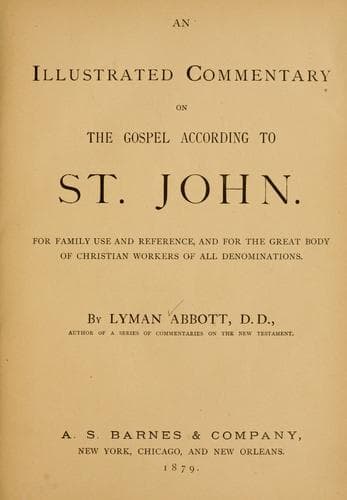
An illustrated commentary on the Gospel according to St. JohnAbbott, Lyman
Religion
An illustrated commentary on the Gospel according to St. John
Abbott, Lyman
Bible. John -- Commentaries
[358] chaps. 1:5,9; 8:12; 12:35, 46.
=4, 5. While it is day; the night cometh.= The day is life; the night
is death. Christ in his human estate was subject to the law under
which all his disciples are placed. Death cut short his human work.
The day for work is short, the night is at hand; therefore the greater
need of earnest and urgent labor. Sleep is a parable of death (Ps.
104:23) that should perpetually remind us that our day is short.=--The
light of the world.= It was prophesied that the Messiah should open
the eyes of the blind (Isa. 29:18; 35:5; 42:7). The direct reference
is to Christ’s fulfilment of these prophecies (Luke 4:18, 21). But it
is true, in a larger sense, that just so far as Christ is in the
world, and accepted by the world, he becomes its light, intellectual,
moral, and spiritual (ch. 1:9, note).
6 When he had thus spoken, he spat[359] on the ground, and
made clay of the spittle, and he anointed the eyes of the
blind man with the clay,
[359] Mark 8:23.
7 And said unto him, Go, wash in the pool of Siloam,[360]
(which is by interpretation, Sent.) He[361] went his way
therefore, and washed, and came seeing.
[360] Neh. 3:15.
[361] 2 Kings 5:14.
=6, 7. Spat on the ground * * * * and he anointed the eyes with the
clay.= Clay and spittle were both believed in ancient times to possess
curative properties. Why Christ used them here is a matter only of
conjecture. Certainly not as remedies, for one blind from birth could
not be cured by a remedy so simple, and he who healed the blind men at
Jericho by a touch (Matt. 20:34) had no need here to resort to other
means. Not to conceal the miracle, as may have been the case in
analogous instances (see Mark 7:33; 8:23, notes), for here his object
was to manifest the works of God, and the result was a public and
protracted investigation of his own character. It is noticeable,
however, that Christ never cured without giving the healed something
to do, as a test of his faith and obedience. Even in the three cases
of raising from the dead he called on the mourners, to indicate by
their obedience to his direction their faith in him (Matt. 9:24, 25;
Luke 7:14; John 11:39, 40). When he was asked to heal, the simple
request served as an indication of faith; when, as here, he
volunteered the cure, he seems always to have required some act as an
evidence of faith. Comp. ch. 5:6-8.--=Go, wash in the pool of Siloam.=
One of the pools in the vicinity of Jerusalem, entitled also Siloah or
Shiloah (Neh. 3:15; Isa. 8:6). It is identified with a pool or tank
still found in the vicinity of Jerusalem, which stands to the south of
the Temple mount, and consists of an oblong tank, partly hewn out of
the rock and partly built of masonry, measuring about fifty-three feet
in length, eighteen feet in width, and nineteen feet in depth, with a
flight of steps leading down to the bottom. Several columns stand out
Public-domain text, read in full here on John Shaqi.
Reviews
Reviews
No reviews yet
Be the first to share your thoughts on this work.
Elsewhere in the archive
Join the Discussion
Join the discussion
Sign in to leave a comment or review.
Sign InorCreate an account