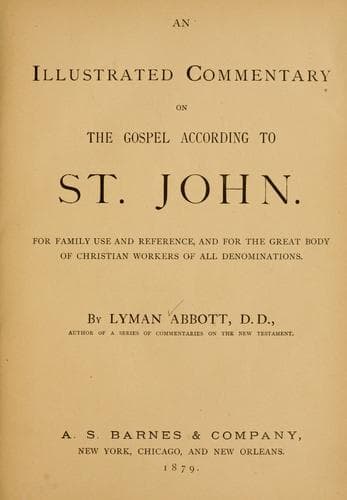
An illustrated commentary on the Gospel according to St. JohnAbbott, Lyman
Religion
An illustrated commentary on the Gospel according to St. John
Abbott, Lyman
Bible. John -- Commentaries
=8, 9. The neighbors therefore, and they which before had seen him
that he was a beggar.= The best manuscripts have _beggar_, not, as in
our English version, _blind_. So Alford and Tischendorf.--=Is not this
he that sat and begged?= Apparently he was a well-known beggar, like
the one described in Acts 3:2, 10. Comp. Luke 18:35. He is described
as one that _sat and begged_, in contrast with such as beg from door
to door. Beggars of this description having a regular place, where
they may always be found soliciting alms, are a not uncommon sight in
the East.--=Some said, This is he. Others, No! but he is like him. He
himself said, I am he.= This is the correct rendering of the best
reading; it varies slightly from our English version. His own response
seems to have settled the question of his identity among the common
people. That some should have at first doubted is not strange,
considering the alterations in appearance made by the clear eye in
place of the sightless eyeballs, and the fact that he was no longer to
be found in his accustomed place, begging.
10 Therefore said they unto him, How were thine eyes opened?
11 He answered and said, A man that is called Jesus made
clay,[362] and anointed mine eyes, and said unto me, Go to
the pool of Siloam, and wash; and I went and washed, and I
received sight.
[362] verses 6, 7.
12 Then said they unto him, Where is he? He said, I know
not.
=10-12.= The first investigation is made informally, and without
prejudice, by the common people. It is curiosity alone which inquires,
and it is easily convinced of the facts in the case.--The man’s reply
to his questioners is more laconic in the original than in our English
version. It is literally, “_And going and washing, I saw._” It reminds
one of Cæsar’s famous report, “I came, I saw, I conquered.” The verb
rendered I saw or I received sight (ἀναβλέπω) is literally, _I saw
again_. Sight being the prerogative of humanity, he speaks as though
it were really once his prerogative (though in fact he never possessed
it), had been lost, and was now recovered to him again.--The question,
_Where is he?_ appears to be asked, not in a spirit of enmity, but
simply from a natural curiosity and interest to see him who had
wrought the cure. Christ’s escape from the blind man and the multitude
is analogous to his course on other occasions (comp. ch. 5:13), and is
characteristic of one who ordinarily avoided all occasions of public
triumph and enthusiasm (ch. 6:15; Matt. 8:4; 9:30; Mark 5:43).
13 They brought to the Pharisees him that aforetime was
blind.
Public-domain text, read in full here on John Shaqi.
Reviews
Reviews
No reviews yet
Be the first to share your thoughts on this work.
Elsewhere in the archive
Join the Discussion
Join the discussion
Sign in to leave a comment or review.
Sign InorCreate an account