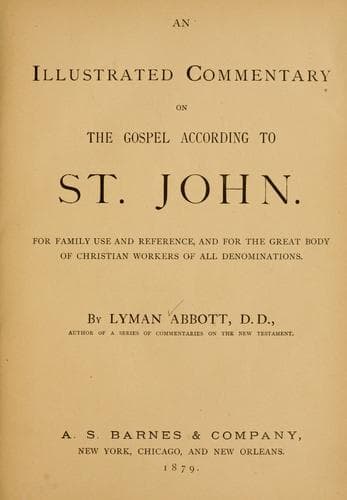
An illustrated commentary on the Gospel according to St. JohnAbbott, Lyman
Religion
An illustrated commentary on the Gospel according to St. John
Abbott, Lyman
Bible. John -- Commentaries
=13.= Verses 13-34 report a semi-official investigation by the
Pharisees, instigated not by a sincere desire to ascertain the truth,
nor by mere curiosity, but by a determination to break the force of
the miracle that had been wrought. For this purpose they first examine
the man (verses 15-17) and his parents (18-21), in hope to prove an
imposture; next they subject the man to a further cross-examination in
an unsuccessful endeavor to break down his testimony (verses 24-33);
failing in that, they do what they can to discredit his testimony by
excommunicating him (ver. 34).--=The Pharisees.= It is generally
supposed that this phrase indicates the Jewish court formally
assembled, either the Sanhedrim, _i. e._, the supreme court of the
nation, or the lesser Sanhedrim, _i. e._, one of the local courts in
Jerusalem. But the passages cited to show that John uses the term
“Pharisees” to designate a court rather indicate the opposite. In both
John 7:32, 45-47 and John 11:46, 47, he distinguishes between the
“chief-priests and Pharisees” who constituted the council, and the
Pharisees who constituted not a body, but a party. I judge then that
the investigation which follows is an informal one. It must be
remembered that in that age, and even to the present time in that
country, no such clear line was drawn as with us between an official
and an unofficial trial.
14 And it was the sabbath day when Jesus made the clay, and
opened his eyes.
15 Then again the Pharisees also asked him how he had
received his sight. He said unto them, He put clay upon
mine eyes, and I washed, and do see.
16 Therefore said some of the Pharisees, This man is not
of God, because he keepeth not the sabbath day. Others
said, How[363] can a man that is a sinner do such miracles?
And[364] there was a division among them.
[363] verse 31; ch. 3:2.
[364] ch. 7:12, 43.
=14-16. The Sabbath day.= For analogous case of Sabbath healing, see
ch. 5, notes.--=Then again the Pharisees also asked him.= Not that
they had asked him before; the “again” refers to the question by the
people in ver. 10.--=Some said * * * * Others said.= It is a mistake
to suppose that all the Pharisees were hypocrites. Among them were
such men as Nicodemus, Joseph of Arimathea, Gamaliel, Saul of Tarsus.
See Matt. 3:7, note. But the honest Pharisees were timid, and were
easily overborne by their opponents. For account of a similar
conflict, see ch. 7:47-52. Observe the inherent vice of Pharisaism,
ancient and modern; it puts the ceremonial above humanity; it is of
the essence of Christianity that it regards all ceremonials and
observances as for humanity (Mark 2:27; note on Matt. 12:8).
17 They say unto the blind man again, What sayest thou
of him, that he hath opened thine eyes? He said, He is a
prophet.[365]
[365] ch. 4:19.
Public-domain text, read in full here on John Shaqi.
Reviews
Reviews
No reviews yet
Be the first to share your thoughts on this work.
Elsewhere in the archive
Join the Discussion
Join the discussion
Sign in to leave a comment or review.
Sign InorCreate an account