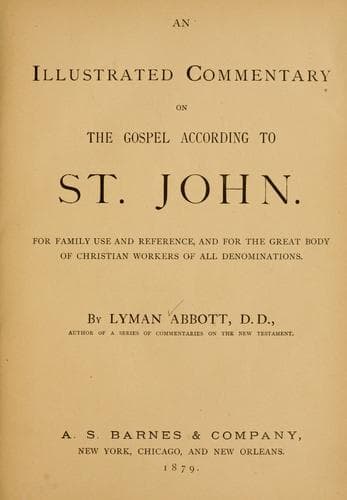
An illustrated commentary on the Gospel according to St. JohnAbbott, Lyman
Religion
An illustrated commentary on the Gospel according to St. John
Abbott, Lyman
Bible. John -- Commentaries
=22, 23. Because they feared the Jews.= The term “Jews,” as John uses
it, generally means the Judeans, _i. e._, the inhabitants of Judea, as
distinguished from the Galileans or other dispersed Israelites. Living
in the vicinity of Jerusalem, they were most attached to its ritual,
and most intolerant of any departure from Jewish ceremonials or any
fellowship with the Gentiles. Through their influence the Sanhedrim
had resolved that any one who acknowledged Jesus as the Messiah should
be excommunicated. When this resolution was arrived at does not
appear. It clearly indicates that even in Judea there was growing a
feeling, if not a faith, that Jesus of Nazareth was the Promised
One.--=He should be put out of the synagogue.= That is, excommunicated.
According to the Jewish scholars, there were three kinds of discipline
known in the ancient synagogues, all of which are entitled
_excommunication_ or _cutting off_. Excommunication in the slightest
degree involved separation from the synagogue, and the suspension of
intercourse with all Jews whatever, even with one’s wife and
domestics. A person who had exposed himself to excommunication was not
allowed to approach another nearer than a distance of four cubits.
This separation was continued for thirty days; and in case the
excommunicated person did not repent, the time might be doubled
or tripled, even when the transgression, by means of which it
was incurred, was of small consequence. The second degree of
excommunication is denominated _the curse_, and was more severe in its
effects. It was pronounced with imprecations, in the presence of ten
men, and so thoroughly excluded the guilty person from all communion
whatever with his countrymen, that they were not allowed to sell him
anything, even the necessaries of life. The _third degree of
excommunication_ was more severe in its consequences than either of
the preceding. It was a solemn and absolute exclusion from all
intercourse and communion with any other individuals of the nation;
and the criminal was left in the hands, and to the justice of God. It
is probable that in the time of Christ the second degree of
excommunication was not distinguished from the third. It is uncertain
what degree of excommunication was here threatened; but it is quite
unimportant, since the first was sure to be succeeded by the others,
unless the condemned repented, and made confession of his wrong-doing;
in this case retracted his confession of Jesus as the Messiah.
24 Then again called they the man that was blind, and said
unto him, Give God[369] the praise: we know that this man
is a sinner.
[369] Josh. 7:19; Ps. 50:14, 15.
25 He answered and said, Whether he be a sinner _or no_, I
know not; one thing I know, that, whereas I was blind, now
I see.
Public-domain text, read in full here on John Shaqi.
Reviews
Reviews
No reviews yet
Be the first to share your thoughts on this work.
Elsewhere in the archive
Join the Discussion
Join the discussion
Sign in to leave a comment or review.
Sign InorCreate an account