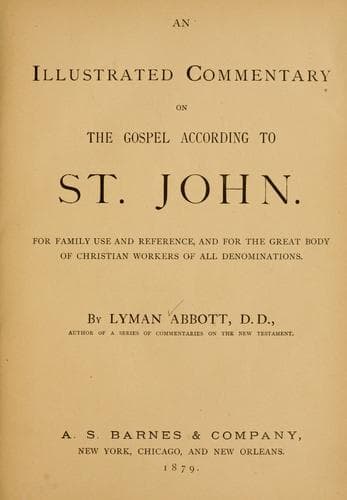
An illustrated commentary on the Gospel according to St. JohnAbbott, Lyman
Religion
An illustrated commentary on the Gospel according to St. John
Abbott, Lyman
Bible. John -- Commentaries
=24, 25.= The Pharisees attempt to overawe the blind man. The
conference with his parents has been held in his absence. They then
summon him into their presence with the declaration that they have
discovered the imposture, and call on him to confess it.--=Give God
the praise= is not equivalent to _Give to God the glory of your cure_;
they do not admit that any cure has been wrought. It is a solemn form
of adjuration to confess the fraud which they pretend to have
discovered (Josh. 7:19).--=We know that this man is a sinner=,
indicates that their investigation has discovered the imposture. The
man’s reply is shrewd and wise. He will not undertake to dispute the
conclusion which these doctors of the law pretend to have reached; but
neither will he abate in the slightest his testimony to the miraculous
cure.--=One thing I know, that being blind, now I see.= No testimony
to Christ is more pertinent or potent than this personal experience of
his grace. Comp. Gal. 1:23; 1 Tim. 1:12-18.
26 Then said they to him again, What did he to thee? how
opened he thine eyes?
27 He answered them, I have told you already, and ye did
not hear: wherefore would ye hear _it_ again? will ye also
be his disciples?
=26, 27.= Defeated in an attempt to overawe the blind man, the
Pharisees resort to the common artifice of cross-examination; they
call on him to repeat his story, in the hope of detecting some real or
imaginary discrepancy in his two accounts, by which they may discredit
him. He refuses to be cross-examined; grows impatient at their manifest
injustice; answers defiantly.--=Ye will not hear.= Equivalent to, Ye
will not heed, will not accept. It is useless to repeat testimony
which they have resolved to reject. He thus illustrates Christ’s
precept, Neither cast ye your pearls before swine (Matt. 7:6).--=Will
ye also be his disciples?= Ironical. The man affects to misunderstand
their object, and to think that they are inquiring for the purpose of
becoming Christ’s disciples. The mere suggestion elicits an indignant
disclaimer, and so brings out clearly that they are not honestly
seeking to get at the truth respecting Jesus, but are attempting to
discredit him. The word _also_ scarcely indicates, as some suppose,
that the man is resolved to become Christ’s disciple. We know too
little concerning him, as yet, to come to that conclusion (ver. 36).
28 Then they reviled[370] him, and said. Thou art his
disciple; but we are Moses’ disciples.
[370] 1 Pet. 2:23.
29 We know[371] that God spake unto Moses: _as for_
this _fellow_, we[372] know not from whence he is.
[371] Ps. 103:7; Heb. 3:5.
[372] ch. 8:14.
Public-domain text, read in full here on John Shaqi.
Reviews
Reviews
No reviews yet
Be the first to share your thoughts on this work.
Elsewhere in the archive
Join the Discussion
Join the discussion
Sign in to leave a comment or review.
Sign InorCreate an account