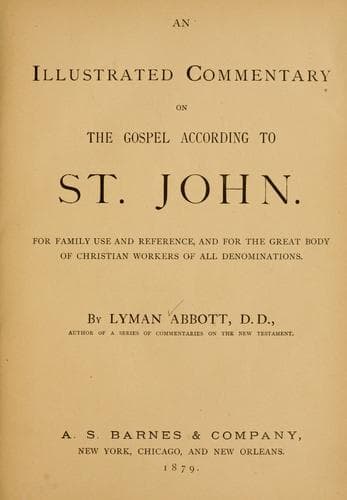
An illustrated commentary on the Gospel according to St. JohnAbbott, Lyman
Religion
An illustrated commentary on the Gospel according to St. John
Abbott, Lyman
Bible. John -- Commentaries
THE CURE OF THE MAN BORN BLIND. It is safe to assume that John has
narrated no event at such length as this miracle and its subsequent
investigation without a definite purpose. The general lessons taught
by this account, apart from those incidentally conveyed in single
utterances, appear to me to be three. (1) This is the only one of
Christ’s miracles which was subjected to a judicial or _quasi_
judicial investigation. That investigation originated not with the
disciples, but with the people, and was carried on before a hostile
tribunal. The identity of the blind man was established by his own
testimony and corroborated by that of his parents. That he was born
blind was established by the same indisputable evidence. That he was
cured was ocularly demonstrated. The cure necessarily involved a
miracle, since congenital blindness is not curable by natural means.
The value of the evidence is increased by the facts that the parents
were reluctant witnesses; that the man himself had no interest to
further the cause of Christ, since he did not even know who he was;
that the Pharisees themselves were forced to the unconscious admission
that a miracle had been wrought (ver. 34, note); and that,
defeated in their attempt to browbeat the witness, they endeavored
to discredit his testimony by excommunicating him. (2) There is an
instructive contrast in the characters so briefly but graphically
portrayed. (_a_) The people, moved by mere wonder, investigate
curiously but not earnestly, reach no conclusion, and so learn nothing
of Christ; (_b_) The Pharisees, instigated by malice and religious
bigotry, investigate thoroughly, and are compelled to adopt the
conclusion that a miracle has been wrought, but refuse to
accept the Worker as even a man sent from God, and so learn nothing of
Christ. (_c_) The parents, honest but timid, accept the facts, but are
unwilling to risk persecution for truth’s sake, and so learn nothing
of Christ. (_d_) The man himself, who is faithful to his convictions,
and whose convictions grow by reason of his fidelity, is brought to a
knowledge of Jesus as the Messiah, the Son of God. Thus is illustrated
the principle that to find the truth as it is in Christ Jesus it is not
enough to investigate curiously, earnestly, honestly; it is necessary
also to confess fearlessly the truth so far as it is apprehended. (3)
The history of the blind man illustrates the growth of faith, as well
as its conditions. At first he knew nothing of Jesus; but without
knowledge or definite hope he obeys Christ’s direction, goes to the
pool of Siloam, washes, sees. He still knows nothing of the Healer but
that he is “a man that is called Jesus.” Despite the timidity of his
parents, and the threatening of the Pharisees, he maintains the truth,
defends the unknown, asserts him to be a prophet, and a man of God.
Finally, he finds in him the Messiah, the Son of God. Fidelity, in that
which is least, is the condition of receiving larger gifts in knowledge
Public-domain text, read in full here on John Shaqi.
Reviews
Reviews
No reviews yet
Be the first to share your thoughts on this work.
Elsewhere in the archive
Join the Discussion
Join the discussion
Sign in to leave a comment or review.
Sign InorCreate an account