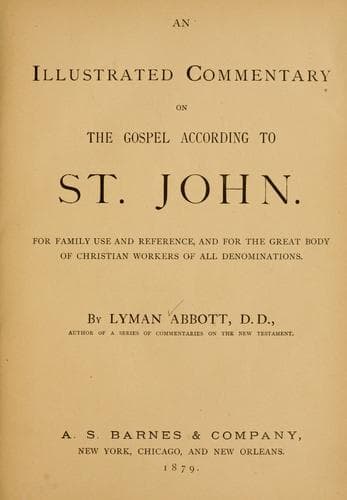
An illustrated commentary on the Gospel according to St. JohnAbbott, Lyman
Religion
An illustrated commentary on the Gospel according to St. John
Abbott, Lyman
Bible. John -- Commentaries
=40, 41. Some of the Pharisees which were with him.= That is, who
happened to be present. But their presence as auditors, coupled
with their question, perhaps implies that they were of that class
which were inclined to regard Jesus as a prophet (ver. 17; ch.
10:21).--=Are we blind also?= The form of the original implies a
strong expectation of a negative reply. It might be rendered, _Surely
we are not blind also_.--=If ye were blind ye should have no sin.=
This is not to be interpreted away, as equivalent to, Your sin would
be less. It is literally true, that sin is in the proportion of
knowledge, so that one who is, by no fault of his own, absolutely
ignorant of moral distinctions, is absolutely free from moral
responsibility.--=Ye say, We see; therefore your sin remains.= They
had the law and the prophets which foretold the Messiah (ch. 5:39),
and they had the knowledge of his works and the moral capacity to
judge them, and did adjudge that God was with him (ch. 3:2), and that
he could not be a sinner (ch. 9:16). This was enough to render them
guilty in not following out their convictions by a public confession
of Christ as a prophet, which they really saw him to be. Comp. ch.
15:24; and with the entire passage (vers. 39-41), Rom. 2:17-24.
CHAPTER X.
Ch. 10:1-21. THE PARABLE OF THE SHEEPFOLD AND THE SHEPHERD.--THE
CHURCH OF CHRIST AS ONE FLOCK.--TO THIS FLOCK THERE IS BUT ONE
DOOR, JESUS CHRIST.--THIS DOOR IS OPENED TO THE SOUL BY THE HOLY
SPIRIT OF GOD.--EVERY ONE WHO ENTERS IN BY THIS DOOR IS SAVED.--AND
BECOMES A MINISTER OF GRACE (A SHEPHERD) TO OTHERS.--THE PATTERN IS
JESUS CHRIST, THE GOOD SHEPHERD.--EVERY TRUE SHEPHERD LIVES FOR THE
FLOCK.--HE WHO DOES NOT IS A HIRELING, AND IS RECREANT IN TIME OF
DANGER.--THE LIFE OF THE FLOCK IS ASSURED BY THE DEATH OF THE GOOD
SHEPHERD.--THAT DEATH WAS NOT COMPELLED; IT WAS VOLUNTARY.
This parable was probably uttered in Judea, and in the immediate
vicinity of Jerusalem. The figure is drawn from the spectacle, likely
at any evening to be witnessed on the hillsides of Judea, a flock
of sheep gathered from the different fields in which they had been
wandering, and _following_ their shepherd, who conducts them to the
sheepfold, which they enter, one by one, for protection, the shepherd
going before and leading them in. To understand aright its meaning, two
facts, often forgotten, must be borne in mind: (1) that the metaphor
is used in the O. T., and for a double purpose; sometimes the shepherd
is the religious teacher of Israel, whose unfaithfulness is rebuked
in the prophets (Jer. 23:1-4; Ezek., ch. 34); sometimes the
shepherd is the Lord, who leads, defends, and feeds the soul which
trusts in him (Ps. 23; Isaiah 40:11); (2) the parable is closely
connected with the discourse concerning blindness, growing out of the
cure of the blind man, and is given for the purpose of emphasizing
and carrying out the warnings therein contained against the Pharisees
Public-domain text, read in full here on John Shaqi.
Reviews
Reviews
No reviews yet
Be the first to share your thoughts on this work.
Elsewhere in the archive
Join the Discussion
Join the discussion
Sign in to leave a comment or review.
Sign InorCreate an account