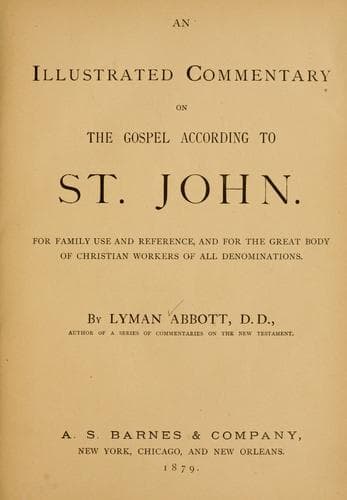
An illustrated commentary on the Gospel according to St. JohnAbbott, Lyman
Religion
An illustrated commentary on the Gospel according to St. John
Abbott, Lyman
Bible. John -- Commentaries
my life.= Not because I _have_ laid it down, as though the love of the
Father were caused by the earthly love and sacrifice of Christ, but
because I _lay_ it down. That is, because Christ’s Spirit is one of
self-sacrificing love, manifested by, but not alone embodied in the
incarnation, he is loved by the Father. See Phil. 2:9; Heb. 1:9.--=In
order that I may take it again.= Beware of understanding this, as many
of the commentators seem to do, as equivalent to, _I die in order that
I may rise from the dead_. The meaning is interpreted by Christ’s
declaration to his disciples: “He that loseth his life for my sake
shall find it.” Christ lays down his life by his humiliation, his
incarnation, his passion and his crucifixion, that he may take it
again in the life of the myriads whom he has redeemed from death by
his own death. He takes it again when he sees of the travail of his
soul and is satisfied (Isa. 53:11), which he does when those who have
been washed and made white in the blood of the Lamb stand before him
(Rev. 7:14, 15). So every mother, laying down her life in continued
self-sacrifice for her children, takes it again in their developed
manhood and womanhood.--=No one taketh it from me, but I lay it down
of myself.= _No one_ is not equivalent to _no man_, a translation
which weakens if it does not destroy the sense. The sacrifice of
Christ, the whole experience of humiliation and suffering, commencing
with the laying aside of the glory which he had with the Father and
culminating in the crucifixion, was not imposed upon him by any one,
neither by man, nor by Satan, nor even by the Father; it was
self-assumed. This fact is the answer to all those objections to the
N. T. doctrine of the atonement, which misrepresent it as portraying a
God who inflicts on an innocent victim the punishment which was
deserved by others.--=I have power to lay it down and I have power to
take it again. This commandment have I received of my Father.= The
word rendered _power_ (ἐξουσία), includes both _power_ and _right_
(see ch. 1:12, note); the word rendered _commandment_ (ἐντολὴ), is
not equivalent to authority; the original word always means _law_
or _command_. Christ’s disciples have no authority to frame
self-sacrifices for themselves; doing this is always characteristic of
a corrupt and _quasi_ pagan religion. They are to bear with cheerful
heroism whatever self-sacrifice the providence of God may lay upon
them. So also they have never a right to seek death, but are always to
seek to _live_ to the glory of God and for their fellow-men. But
Christ voluntarily chose his life of humiliation and cross-bearing;
voluntarily sought its privations; and finally went, not to an
inevitable death, but to one which he might easily have avoided by
flight, if he had acted according to the directions which he gave his
followers, and on which the apostle subsequently acted. He might have
fled from Jerusalem on the fatal night of his arrest, as he had done
Public-domain text, read in full here on John Shaqi.
Reviews
Reviews
No reviews yet
Be the first to share your thoughts on this work.
Elsewhere in the archive
Join the Discussion
Join the discussion
Sign in to leave a comment or review.
Sign InorCreate an account