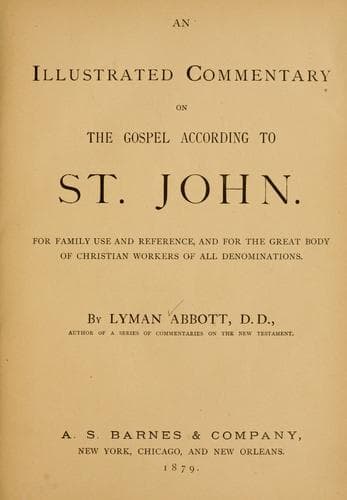
An illustrated commentary on the Gospel according to St. JohnAbbott, Lyman
Religion
An illustrated commentary on the Gospel according to St. John
Abbott, Lyman
Bible. John -- Commentaries
before, and this without leaving his sheep to be seized or scattered
by the wolf; or he might have been protected by supernatural power
(Matt. 26:53). He did not because he had a peculiar authority given to
him, which his followers do not possess, to lay down his own life,
both in the self-assumed humiliation of the incarnation, and in the
final tragedy of his death. And this peculiar authority he possessed
because in all his incarnation and passion and death he was carrying
out the will and obeying the command of his Father. To us the
divine command is interpreted by providence; Christ needed no such
interpreter, for he knew the Father’s will, knowing the Father even as
he was known by the Father.
19 There was a division therefore again among the Jews for
these sayings.
20 And many of them said, He[408] hath a devil, and is mad;
why hear ye him?
[408] ch. 7:20.
21 Others said, These are not the words of him that hath a
devil. Can a devil open[409] the eyes of the blind?
[409] ch. 9:6, etc.
=19-21. There was a division therefore again among theJews.=--Christ’s
fan was in his hand. His teachings were tests of the character of his
auditors.--=He hath a devil.= Rather _an evil spirit_ (see ch. 8:52,
note).--=Why hear ye him?= Why listen to him at all? The words were
addressed by the opponents of Jesus to those who were inclined to
believe on him, and indicate the uneasiness with which the Pharisees
observed the impression which Christ was making on the less prejudiced
and better disposed among the people (comp. ch. 7:46-49).--=These are
not the words of one possessed by an evil spirit.= A pregnant saying.
Infidelity must afford some explanation of the teachings and life of
Christ; and they are not the teachings and life of either a fanatic or
a deceiver.--=Can an evil spirit open the eyes of the blind?= These
words show that the whole discourse of this chapter was not distant in
time from the healing of the blind man narrated in Chapter IX, and was
probably closely connected with it.
* * * * *
Ch. 10:22-42. DISCOURSE AT THE FEAST OF DEDICATION.--THE GIFT
OF CHRIST: ETERNAL LIFE.--THE POWER OF CHRIST: THE POWER OF THE
FATHER.--THE CONTRAST BETWEEN THE O. T. PROPHETS AND CHRIST.--THE
EVIDENCE OF CHRIST’S DIVINITY; HIS WORKS.
There is no reason to suppose that Christ left Judea during the time
which elapsed between the feast of Tabernacles (ch. 7:2) and
the feast of Dedication; on the contrary, the intimate connection
between the discourse here reported and the preceding parable of the
Good Shepherd (see vers. 26, 27), indicates that this discourse
followed almost immediately after that one; certainly while the latter
was still fresh in the minds of the people. I believe that the ministry
in Judea, reported in John, chapters 7, 8, 9 and 10, was a continuous
one, unbroken by any departure into Galilee or Perea.
Public-domain text, read in full here on John Shaqi.
Reviews
Reviews
No reviews yet
Be the first to share your thoughts on this work.
Elsewhere in the archive
Join the Discussion
Join the discussion
Sign in to leave a comment or review.
Sign InorCreate an account