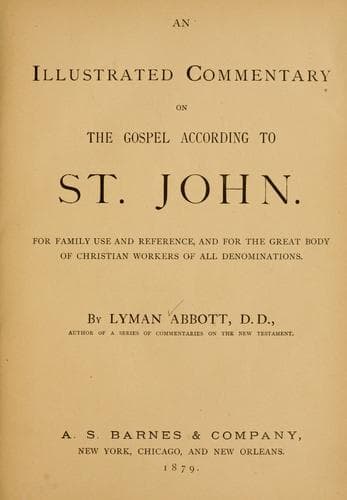
An illustrated commentary on the Gospel according to St. JohnAbbott, Lyman
Religion
An illustrated commentary on the Gospel according to St. John
Abbott, Lyman
Bible. John -- Commentaries
These verses (34-36) have been sometimes regarded as a partial
retraction, or at least a material modification of the declaration, “I
and my Father are one;” as indicating that Jesus Christ is a Son of
God only as every obedient soul is a child of God (1 John 3:1). If
this passage stood alone, such an interpretation might possibly be
given to it; but if the audience, the circumstances, the effect, and
the other utterances of the speaker be taken into account, it cannot
be fairly so understood. This sentence is spoken to a mob for the
purpose of checking their rage. They have understood Christ to claim
divinity. He does not in terms explicitly disavow it. On the contrary,
when his explanation is ended, they resume their design (ver. 39), and
he is obliged to flee for his life. We should not look in such an
utterance for a disclosure of the profoundest truths respecting
Christ’s character, not because Christ would conceal or modify the
truth to save his life, but because an angry mob is not the sort of an
audience to whom he would choose to reveal it, or indeed could reveal
it, a certain receptiveness of soul being necessary to the
comprehension of spiritual truth. The argument of these verses seems
to me to be this: He to whom the Spirit of God comes, and who receives
it and becomes in so far an exponent and manifestation of God, is in a
sense divine; he becomes partaker of the divine nature; a sharer of
the divine life (Rom. 8:29; Heb. 12:10; 2 Pet. 1:4). This is the
testimony of the Scriptures which cannot be set aside. He, then, who
is not of this world but from above (ch. 8:23), and whom the Father
consecrated above and sent down into this world, is not guilty of
blasphemy in calling himself a Son of God. In other words, Christ
compares himself with inspired men only to contrast himself with them;
he shows that, even according to the principles of the O. T.
Scriptures, by which the Jews pretended to condemn him, he was not
guilty of blasphemy, even if, being but a man, he had made himself a
son and so a representative of God, while he, at the same time,
clearly claims to be other and higher than the O. T. prophets and
judges. But for the full disclosure of Christ’s character, we must
look to his quiet conferences with his own disciples, who were at
least willing, if not able, to understand him.
37 If[422] I do not the works of my Father, believe me not.
[422] ch. 14:10, 11; 15:24.
38 But if I do, though ye believe not me, believe the
works: that ye may know, and believe, that the Father _is_
in me, and I in him.
Public-domain text, read in full here on John Shaqi.
Reviews
Reviews
No reviews yet
Be the first to share your thoughts on this work.
Elsewhere in the archive
Join the Discussion
Join the discussion
Sign in to leave a comment or review.
Sign InorCreate an account