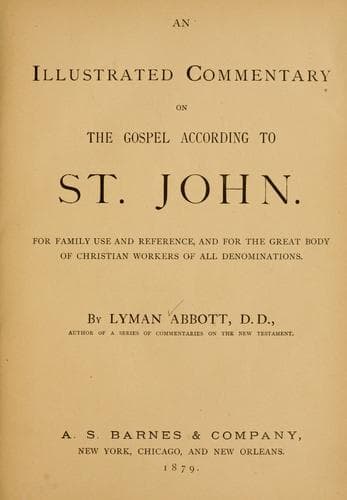
An illustrated commentary on the Gospel according to St. JohnAbbott, Lyman
Religion
An illustrated commentary on the Gospel according to St. John
Abbott, Lyman
Bible. John -- Commentaries
=39-42. They sought again to take him.= To arrest him. Their passion
had time to cool, and they abandoned the idea of mob violence, which
would have brought, as in Paul’s case (Acts 21:31, 32), the
interference of the Romans. Instead, they endeavored to seize Christ
and bring him before the authorities for trial.--=But he escaped out
of their hand.= There is no reason to suppose a miracle. In the throng
were some at least who believed in him, and under cover afforded by
them he could have escaped.--=Where John at first baptized.= See ch.
1:28, note.--=All things that John spake of this man were true.= Being
dead he yet spake. Gave his testimony to Christ. See ch. 1:15-34. This
was the end of Christ’s Judean ministry proper, which had lasted three
months. It had been one of continuous storm. Twice during this period
he had been mobbed (ch. 8:59; 10:31); once an attempt was made to
arrest him (ch. 7:32, 45); secret plans for his assassination
were laid (ch. 7:19, 25; 8:37). All that we know of this ministry
is contained in John, chapters 7, 8, 9 and 10; though it is not
improbable that the parables of the Good Samaritan and the Pharisee
and the Publican, and the incidents at the house of Mary and Martha
belong to the same era (Luke 10:25-42; 18:9-14).--=And many believed
on him there.= A period of a little over three months, from some time
in December to the first of April, intervened between the retreat of
Christ from Judea and his final entry into Jerusalem at the Passover
week. I believe that this time was devoted to his ministry in Perea,
the district beyond Jordan; a ministry of which John here gives a
hint, to which Matthew and Mark also refer (Matt. 19:1, 2, etc.; Mark
10:1, etc.), but of which Luke alone gives any full account. See Luke,
ch. 10, Prel. Note. Many thronged his ministry there (Luke 11:29;
12:1; 14:15, 25; 15:1). This ministry was broken in upon by the
message from the sisters of Lazarus, as recorded in the next chapter.
See Prel. Note there.
CHAPTER XI.
Ch. 11:1-44. THE RESURRECTION OF LAZARUS.--THE DIVINE OBJECT IN ALL
SEEMING EVIL: NOT HUMAN DEATH BUT DIVINE GLORY (4).--THE MYSTERY OF THE
DIVINE SILENCE IN OUR SORROW ILLUSTRATED AND PARTIALLY INTERPRETED (6,
12).--THE CONDITIONS OF DIVINE PROTECTION AND THE CHRISTIAN’S SAFETY
(9, 10).--THE CHRISTIAN’S DEATH A SLEEP (11).--THE ANGUISH OF “IF” (21,
32).--THE PHARISAIC CREED AND THE CHRISTIAN’S FAITH CONCERNING DEATH
AND THE RESURRECTION CONTRASTED (23-27).--CHRIST’S INDIGNATION AT HUMAN
FALSEHOOD (33, 38).--CHRIST’S SYMPATHY WITH HUMAN SORROW (35).--THE
RESISTANCE OF FAITHLESSNESS; THE OBEDIENCE OF FAITH (39, 41).--THE
PRAYER OF ASSURANCE OF FAITH (42).--THE RESURRECTION AND THE LIFE (43,
44).--A PARABLE OF HUMAN SORROW AND DIVINE COMFORT.--A PARABLE OF HUMAN
SIN AND DIVINE REDEMPTION. See Supplementary Note.
Public-domain text, read in full here on John Shaqi.
Reviews
Reviews
No reviews yet
Be the first to share your thoughts on this work.
Elsewhere in the archive
Join the Discussion
Join the discussion
Sign in to leave a comment or review.
Sign InorCreate an account