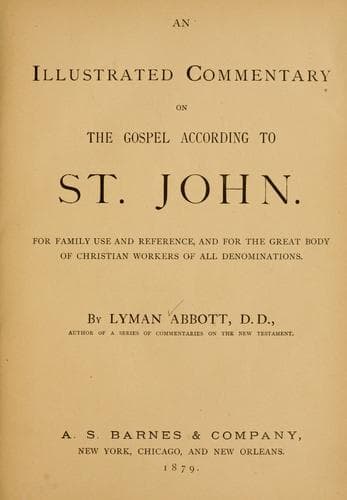
An illustrated commentary on the Gospel according to St. JohnAbbott, Lyman
Religion
An illustrated commentary on the Gospel according to St. John
Abbott, Lyman
Bible. John -- Commentaries
PRELIMINARY NOTE.--There is nothing in John to indicate the time at
which this miracle took place; and there is no general agreement
among harmonists respecting it. Robinson places it immediately at
the close of Christ’s Judean ministry and prior to his ministry in
Perea; Andrews and Ellicott place it at the close of the Perean
ministry and immediately preceding the Passion week. The reasons
for so doing are: (1) It seems the immediate occasion both of the
triumphal procession accorded to Jesus by the spontaneous action of
the common people, and of the more deliberate determination on the
part of the ecclesiastics of Jerusalem to put him to death. It does
not seem reasonable, therefore, to suppose that a long period of
active service in another part of the Holy Land intervened between
this the greatest miracle wrought by Christ and the effects which it
produced, both upon the church party and upon the common people. (2)
Immediately after this miracle, and in consequence of the excitement
produced by it, Christ retired into the wilderness, and is said by
John to have continued there with his disciples; and the
implication is that he remained in this retirement until after the
Passover (vers. 54, 55). To suppose that the Perean ministry,
which lasted something like three months, was interjected into this
period of retirement, which is Robinson’s supposition, breaks into the
continuity of John’s narrative, and does violence to its order and
symmetry, without any adequate reason. (3) Jesus was at a considerable
distance from Bethany at the time when Lazarus was taken sick. The
sisters sent unto him at once; after receiving their message, he
remained where he was two days; but when he reached Bethany, Lazarus
had been four days dead (comp. vers. 6 and 39). Presumptively,
therefore, he was at least one day’s journey from Bethany, even if
we assume that Lazarus had died before the messengers had reached
Jesus; more probably he was two days’ journey distant, for verse
11 indicates that the death of Lazarus took place after Jesus had
received word of his sickness. Thus the narrative of this miracle
tallies with the supposition that Christ was carrying on his ministry
in the region beyond the Jordan, rather than with the supposition that
he was anywhere in Judea; the more so that we have no intimation in
the Gospels of any ministry in Judea except in and about Jerusalem,
of which Bethany was practically a suburb. (4) In Luke 13:32, Christ
uses the following language: “Behold I cast out devils and I do cures
to-day and to-morrow, and the third day I shall be perfected.” This
occurs in the Perean ministry, and the “two days” here referred to,
have been hypothetically identified with the “two days” during which,
according to John’s narrative here, Jesus tarried where he was after
receiving the message of Lazarus’s sickness. The coincidence between
the two passages is at least curious, though it may be nothing more
than a coincidence.
Public-domain text, read in full here on John Shaqi.
Reviews
Reviews
No reviews yet
Be the first to share your thoughts on this work.
Elsewhere in the archive
Join the Discussion
Join the discussion
Sign in to leave a comment or review.
Sign InorCreate an account