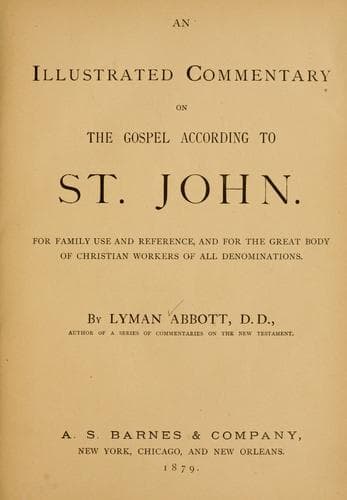
An illustrated commentary on the Gospel according to St. JohnAbbott, Lyman
Religion
An illustrated commentary on the Gospel according to St. John
Abbott, Lyman
Bible. John -- Commentaries
These reasons make the chronology of Andrews and
Ellicott more probable than that of Robinson. I believe, then, that the
resurrection of Lazarus took place in the latter part of February or
the early part of March A. D. 30, and that it was followed, after the
brief retirement at Ephraim, by the triumphal march of Christ and his
disciples up to Jerusalem, and by his Passion and his death there. See
_Tab. Har._, Vol. I, p. 45; for some general considerations respecting
this miracle, see Sup. Note, ver. 44.
1 Now a certain _man_ was sick, _named_ Lazarus, of
Bethany, the town of[425] Mary and her sister Martha.
[425] Luke 10:38, 39.
2 (It was _that_ Mary which[426] anointed the Lord with
ointment, and wiped his feet with her hair, whose brother
Lazarus was sick.)
[426] ch. 12:3; Mark 14:3.
=1, 2. Now a certain one was sick named Lazarus.= The only historic
person of this name mentioned in the Bible; the indications are
that he was a younger brother. From the incident in Luke 10:38-42,
we judge that Martha was the head of the household. Simon, probably
the father, though possibly the husband of one of the sisters, was a
leper; he had probably died or been banished by the law, because of
his leprosy (Matt. 26:6). The family appear to have been one
of wealth and social distinction; this is indicated by the facts that
they owned their house, had their tomb in their garden, and were able
to give three hundred dollars worth of ointment as a costly token of
honor to Jesus (John 12:5). I say three hundred dollars worth
because the penny, or denarius, was a day’s wages, and therefore
equivalent to our dollar. How and where the household first became
acquainted with Jesus, we do not know. An ingenious writer in _Smith’s
Bible Dictionary_ endeavors to identify Lazarus with the rich young
ruler who had great possessions, and went away from Christ sorrowful
because he was bid to sell all that he had to give to the poor
(Matt. 19:16-22); but this ingenious hypothesis has only its
ingenuity to commend it. Of Lazarus’s life after his resurrection,
nothing whatever is known; there are traditions respecting him, and
his bones were discovered by some of the credulous relic-worshippers
of the ninth century in the island of Cyprus; but the traditions are
as little to be trusted as the relics.--=Of Bethany.= This village
lies on the eastern slope of the Mount of Olives, less than two miles
(ver. 18, note) southeast of Jerusalem. See for description
and illustration, ch. 12:1, 2, note. Its present name is El-Azarieh,
derived from, and memorializing the resurrection of Lazarus. Of
course, the house of Simon and of Lazarus, and the tomb of the latter
are pointed out to the traveler by the accommodating monks, and of
course, nothing is known about either of these sites, except that
the tomb cannot possibly be the real one. It is a deep vault partly
lined with masonry, entered upon by a long, winding, half-ruined
Public-domain text, read in full here on John Shaqi.
Reviews
Reviews
No reviews yet
Be the first to share your thoughts on this work.
Elsewhere in the archive
Join the Discussion
Join the discussion
Sign in to leave a comment or review.
Sign InorCreate an account