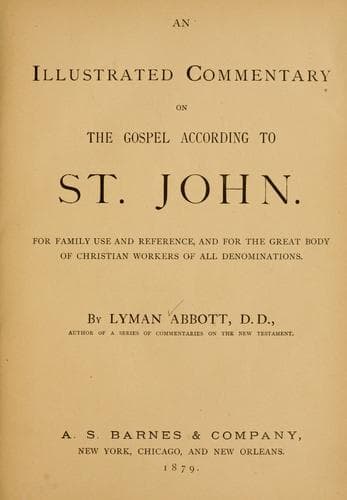
An illustrated commentary on the Gospel according to St. JohnAbbott, Lyman
Religion
An illustrated commentary on the Gospel according to St. John
Abbott, Lyman
Bible. John -- Commentaries
=3, 4. Lord, behold whom thou lovest is sick.= They have complete
confidence in the sympathy of their Lord; they do not urge him to come;
they do not present any petition; they simply report their trouble to
him.--=He said, This sickness is not unto death.= That is, has not
death for its object; (πρὸς with the accusative, marks strictly the
object towards which anything is directed.) Christ does not say that
Lazarus will not die, but that death is not the end for which this
sickness is ordained of God.--=But for the glory of God, that the Son
of God might be glorified thereby.= Comp. ch. 9:3, note. He was
glorified, (1) perhaps by the development of a higher spiritual life
in Lazarus through his sickness, death and resurrection (_Trench_),
though of this the Evangelist gives us no hint; (2) by the
manifestation of the divine power of Jesus Christ, as one whom the
Father always hears (ver. 42); (3) by the Passion and death of Jesus
Christ, to which the resurrection of Lazarus directly led (vers.
47-53). This saying of Christ seems to have been uttered not merely to
his disciples; it was apparently his message to the sisters, and to it
he refers in verse 40 (see note there).
5 Now Jesus loved Martha, and her sister, and Lazarus.
6 When he had heard therefore that he was sick, he abode
two days still in the same place where he was.
7 Then after that saith he to _his_ disciples, Let us go
into Judæa again.
=5-7. Now Jesus loved Martha=, etc. This statement is made in
explanation of verse 6, that the reader may not fall into the error of
supposing that Christ’s delay was due to any indifference or unconcern
on his part.--=He abode two days in the same place where he was.= Why?
Either because this delay was necessary to complete the work in which
he was engaged, and from which he would not suffer himself to be drawn
away even by considerations of personal sympathy, he himself acting on
the principle “Let the dead bury their dead, but go thou and preach
the kingdom of God” (Luke 9:60); or because this delay was necessary
to the consummation of the miracle of the resurrection of Lazarus in
such form as to forever prohibit the impression that death had not
really taken place. The former is the better hypothesis, since in no
case does Christ seem to have wrought a miracle for the mere purpose
of producing by it a profound impression, and it is therefore hardly
consistent to believe that he would have delayed merely for the
purpose of making the miracle more startling and marvelous.--=Let us
go into Judea again.= This plainly implies that Jesus and his
disciples were not then in Judea, and thus incidentally confirms the
supposition (see Prel. Note) that the resurrection of Lazarus was
subsequent to the close of the ministry in Perea, and that he was
summoned from Perea.
8 _His_ disciples say unto him, Master, the Jews of
late[429] sought to stone thee; and goest thou thither
again?[430]
Public-domain text, read in full here on John Shaqi.
Reviews
Reviews
No reviews yet
Be the first to share your thoughts on this work.
Elsewhere in the archive
Join the Discussion
Join the discussion
Sign in to leave a comment or review.
Sign InorCreate an account