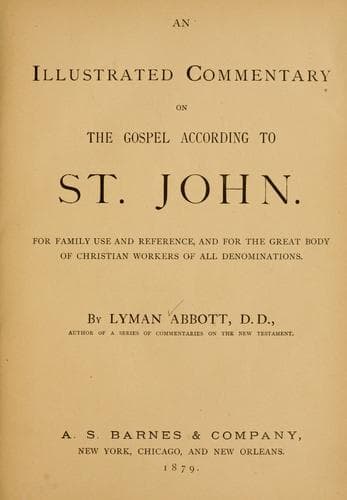
An illustrated commentary on the Gospel according to St. JohnAbbott, Lyman
Religion
An illustrated commentary on the Gospel according to St. John
Abbott, Lyman
Bible. John -- Commentaries
[429] ch. 10:31.
[430] Acts 20:24.
9 Jesus answered, Are there not twelve hours in the day?
If[431] any man walk in the day, he stumbleth not, because
he seeth the light of this world.
[431] ch. 12:35.
10 But if a man walk in the night,[432] he stumbleth,
because there is no light in him.
[432] Eccles. 2:14.
=8-10. The disciples say to him, Master, the Judeans were just now
seeking to stone thee.= On the chronological hypothesis adopted above,
the mob in Jerusalem had threatened the life of Jesus about three
months previous. But he had not been in Judea since. The disciples
attributed Christ’s remaining in Perea to the fear of the Jews, and
remonstrated against his again braving them.--=Jesus answered, Are
there not twelve hours in the day=, etc. In interpreting Christ’s
enigmatical saying here, the student must remember that it was his
habit to speak in parables, and that he rarely gave any interpretation
of them. This is to be regarded as a condensed and uninterpreted
parable. John has himself given us the key to its interpretation by
his use of the same metaphor in his Epistle (1 John 1:5-7). God is the
light. As he has appointed the hours of activity for the human race,
the twelve hours of the day, so he has appointed the hours of service
for each individual man. What was true of Christ is true of every one;
he cannot die until his time has come (John 7:6, 8, 30; 8:20). He
therefore who walks with God in the path of duty, fulfilling the
divine will, cannot stumble; no harm can come to him; not a hair of
his head can be injured (Psalm 91; Matt. 10:29-31; Luke 10:19; 21:18).
He may and must come to his death; but not until his twelve hours have
passed away.--But if a man work in darkness, _i. e._, not with God,
not in the path of duty, not endeavoring to fulfil the divine will,
for him there is no assurance of protection; he is always liable to
stumble and fall. This is the general principle which Christ
parabolically asserts; its immediate application here is that to
Christ there is no danger in going into Judea, for he will not die
until his appointed time has fully come. Comp. ch. 9:4, note.
11 These things said he: and after that he saith unto them,
Our friend Lazarus sleepeth:[433] but I go, that I may
awake him out of sleep.
[433] Deut. 31:16; Acts 7:60; 1 Cor. 15:18, 51.
12 Then said his disciples, Lord, if he sleep, he
shall do well.
13 Howbeit Jesus spake of his death: but they thought
that he had spoken of taking of rest in sleep.
Public-domain text, read in full here on John Shaqi.
Reviews
Reviews
No reviews yet
Be the first to share your thoughts on this work.
Elsewhere in the archive
Join the Discussion
Join the discussion
Sign in to leave a comment or review.
Sign InorCreate an account