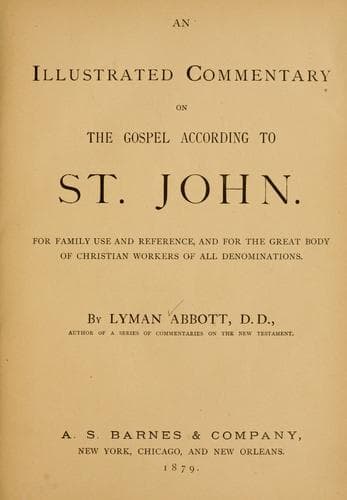
An illustrated commentary on the Gospel according to St. JohnAbbott, Lyman
Religion
An illustrated commentary on the Gospel according to St. John
Abbott, Lyman
Bible. John -- Commentaries
=11-13. Our friend Lazarus sleepeth.= An interval is indicated as
having taken place between the previous discourse and the present
declaration, by the words, _after that he saith unto them_. _Our
friend_, implies that Lazarus was loved by the disciples as well
as by their Lord. This language, coupled with that of verse 3,
indicates that he possessed a peculiarly lovable character. _Sleep_
is used both in the O. T. and N. T. as a metaphor of death (2
Chron. 14:1; Ps. 13:3; Jer. 51:57; Job 14:12; Dan. 12:2; Matt.
27:52; Acts 7:60; 13:36; 1 Cor. 7:39; 11:30; 15:6, 18, 20, 51; 1
Thess. 4:13, 14, 15). Some of the rationalistic critics think
that the disciples were extraordinarily stupid, not to understand
Christ’s metaphor; and yet they are guilty of a similar but greater
stupidity. Thus, the author of _Supernatural Religion_ says (Vol.
II, 460): “The disciples reply with the stupidity with which
the fourth Evangelist endows all those who hold colloquy with
Jesus: (Lord, if he has fallen asleep he will recover;)” and yet,
on the immediately preceding page, he interprets Christ’s similar
declaration respecting the daughter of Jairus (Matt. 9:24):
“The maid is not dead but sleepeth,” as “an express declaration” that
the case is “one of mere suspension of consciousness.” The
misapprehension of the apostles here was not extraordinary; certainly
not more so than that afforded by some analogous instances in the
first three Gospels (see Matt. 16:7; Luke 22:38). They had understood
from verse 4, that Lazarus was to be restored; they had interpreted
Christ’s words as a promise of healing; they had witnessed cases of
miraculous healing in at least two instances, wrought by a word on an
absent patient (Luke 7:10; John 4:50-53); so when Jesus said, “Lazarus
is sleeping,” they thought the crisis of the disease had passed, and
that there was no reason why their Master should brave the dangers of
a Judean mob to go to the bedside of a convalescent friend.
14 Then said Jesus unto them plainly, Lazarus is dead;
15 And I am glad for your sakes that I was not there, to
the intent ye may believe; nevertheless let us go unto him.
16 Then said Thomas, which is called Didymus, unto his
fellow-disciples, Let us also go, that we may die with him.
Public-domain text, read in full here on John Shaqi.
Reviews
Reviews
No reviews yet
Be the first to share your thoughts on this work.
Elsewhere in the archive
Join the Discussion
Join the discussion
Sign in to leave a comment or review.
Sign InorCreate an account