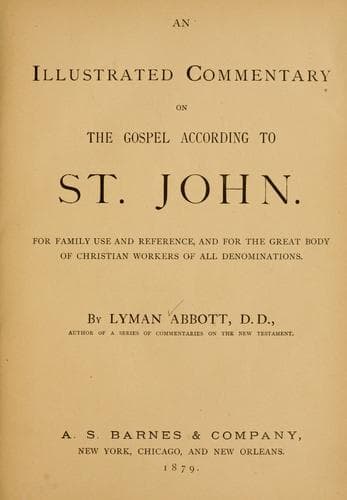
An illustrated commentary on the Gospel according to St. JohnAbbott, Lyman
Religion
An illustrated commentary on the Gospel according to St. John
Abbott, Lyman
Bible. John -- Commentaries
=17, 18. He had lain in the grave four days already.= Various
explanations are made respecting these four days; they are given in
detail in _Andrews’ Life of Our Lord_. Since, however, we do not know
definitely where Christ was, except that it was some point apparently
beyond Jordan, and we do not know at all what engagements and duties
detained him there, surmises as to the way in which these four days
were taken up are decidedly unprofitable. The narrative seems to me
clearly to imply that Lazarus was not dead when the messengers first
reached Jesus. Probably of these four days, two were occupied by
Christ in completing his ministry where he was when he received the
message, and two, or part of two days, in a leisurely journey to the
home of Lazarus.--=Bethany was nigh unto Jerusalem.= The use of the
past tense _was_, not _is_, indicates that Bethany had ceased to exist
at the time when John wrote his Gospel; it thus incidentally confirms
the opinion that he wrote a considerable time after the destruction of
Jerusalem, and when that city and its environs were lying
waste.--=About fifteen furlongs off.= Literally, _stadia_. The
_stadium_, is about six hundred feet; fifteen stadia or furlongs were,
therefore, about nine thousand feet, or a little less than two miles.
19 And many of the Jews came to Martha and Mary, to[434]
comfort them concerning their brother.
[434] 1 Chron. 7:22; Job 2:11; 42:11; Rom. 12:15; 1
Thess. 4:18.
=19. And many of the Judeans came to Martha and Mary.= The word
_Jews_, as used by John, indicates always the inhabitants of Judea, as
distinguished from those of other provinces in the Holy Land, and
therefore generally those who were prejudiced against, if not
absolutely hostile to Jesus. The fact that most of those who were
present at the scene about to be described were these Judeans, is an
important one, and must be borne in mind by the student, for it gives
a peculiar color and significance to the entire narrative.--=To
comfort them concerning their brother.= The Jewish mourning rites were
most carefully defined by the Rabbinical law; they included rending
the clothes, dressing in sackcloth, sprinkling of ashes or dust on the
person, fasting, loud lamenting. Professional mourners were employed
to increase the noisy demonstrations of grief (see Mark 5:38, note).
The days of mourning were thirty, which were divided into three for
weeping, seven for lamentation, and twenty for less demonstrative
mourning. During the first three days the mourners were forbidden to
wear their phylacteries or to engage in any servile work, or to bathe
or anoint themselves; during the seven days they fasted or ate nothing
but an occasional egg or some lentiles. After the funeral services
were over (for account of which see Luke 7:12, note), friends and
professional mourners came and sat with the afflicted ones upon the
ground, no one speaking until the bereaved ones had done so, but every
Public-domain text, read in full here on John Shaqi.
Reviews
Reviews
No reviews yet
Be the first to share your thoughts on this work.
Elsewhere in the archive
Join the Discussion
Join the discussion
Sign in to leave a comment or review.
Sign InorCreate an account