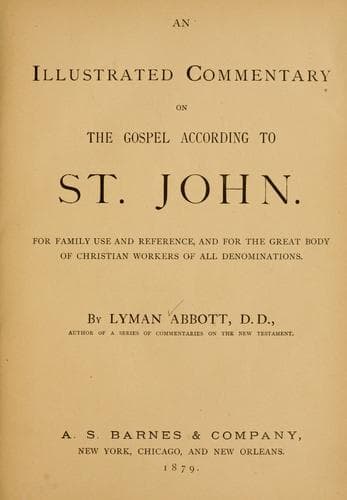
An illustrated commentary on the Gospel according to St. JohnAbbott, Lyman
Religion
An illustrated commentary on the Gospel according to St. John
Abbott, Lyman
Bible. John -- Commentaries
sentence of theirs was followed by some word of sympathy and comfort
or by the wail of the mourners. Everything was done according to a
prearranged system; in Phariseeism there was no liberty, even in the
hour of grief.
20 Then Martha, as soon as she heard that Jesus was coming,
went and met him: but Mary sat _still_ in the house.
21 Then said Martha unto Jesus. Lord, if thou hadst been
here, my brother had not died.
22 But I know, that even now, whatsoever[435] thou wilt ask
of God, God will give _it_ thee.
[435] ch. 9:31.
=20-22. Then Martha * * * went and met him.= Jesus did not enter into
the village, but stopped without and sent some one to let the sisters
know that he had come. Geikie supposes that he thus remained without
from fear of the Jews; but Christ never stopped in the performance of
a duty from considerations of fear; his reply to the remonstrances of
his disciples (vers. 8-10) should have prevented this prosaic
interpretation of Christ’s action. To him the conventional mourning
customs of Oriental society were exceedingly distasteful. He who put
all the noisy mourners out of the room in which the daughter of Jairus
lay dead (Mark 5:40), and who so gently rebuked the noisy and
ostentatious lamentations of the women of Jerusalem at the time of his
own crucifixion (Luke 23:27-31), might naturally be expected to
decline to enter into the circle of formal mourners, with the
alternative of either violating the precedents and rules of good
society, or of submitting himself in such an hour to the bondage which
they imposed.--=But Mary sat still in the house.= It would appear from
verse 29, that she did not know that Jesus had come; yet the contrast
between the two sisters, the one of whom with bustling activity waited
upon her Lord, the other of whom, in the quieter offices of love, sat
at his feet to listen to his words, or anoint those feet with precious
ointment (Luke 10:38-42; John 12:1-8), reappears here. Martha, who was
probably the head of the household, was naturally the first to hear of
Christ’s coming, and even in her grief found comfort in activity; to
Mary, in the solitude of her sorrow, no one at first reported Christ’s
approach.--=Lord, if thou hadst been here, my brother had not died.=
This is the language both of reproach and of lamentation, though the
reproach is implied rather than asserted. Her language expresses the
very essence of soul torture at such times. We are slow to believe
that our sorrow is “for the glory of God that the Son of God may be
glorified thereby,” and in our affliction continually echo Martha’s
“if,” saying to ourselves, if we had not done this, or if we had not
done that, if it had not been for our blunder or that of our friends
or our physician, our beloved would not have died. Chance is the God
of Atheism, and is a comfortless God in the time of our trouble.--=But
I know that even now whatsoever thou shouldst ask of God, God will
Public-domain text, read in full here on John Shaqi.
Reviews
Reviews
No reviews yet
Be the first to share your thoughts on this work.
Elsewhere in the archive
Join the Discussion
Join the discussion
Sign in to leave a comment or review.
Sign InorCreate an account