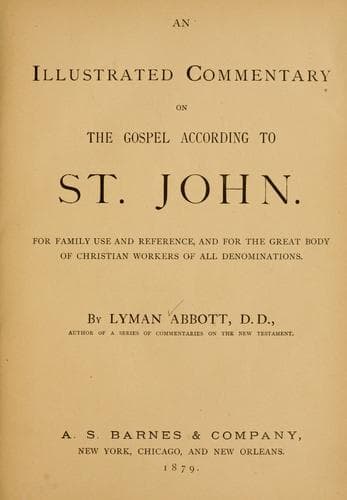
An illustrated commentary on the Gospel according to St. JohnAbbott, Lyman
Religion
An illustrated commentary on the Gospel according to St. John
Abbott, Lyman
Bible. John -- Commentaries
=8, 9.= An early Gnostic sect (second century) believed that John was
the Messiah. The primary reference here appears to be to this error,
which, in common with other Gnostic errors (see Prel. Note),
John aims to correct in this introduction to his Gospel. Compare, with
the declaration here, Christ’s characterization of John, “He was a
burning and a shining light” (ch. 5:35). The Greek scholar will
observe that the English word “_light_” represents different Greek
words in the two passages. Here the word is one signifying original
light (φῶς), there rather a borrowed or reflected light (λύχνοσ),
though the latter word is once applied to Christ (Rev. 21:23).
We are to be in a true sense the former kind of light (φῶς, Matt.
5:14), because Christ _in us_ is our light, and by his indwelling
we are made partakers of his nature (2 Pet. 1:4), and men seeing
this light glorify, not us, but Him who shines in and through
us.--=The true Light was that which lighteth every man that cometh into
the world.= There is some difficulty about the construction of this
sentence; this appears to me to be the best. For other constructions,
see Alford and Meyer. On the meaning of the declaration observe,
(1) That John’s use of the word _true_ here is interpreted by his
use of the same word in other and analogous passages, _e. g._, “true
worshippers” (John 4:23); “true bread” (ch. 6:32); “true vine” (ch.
15:1). The light, the bread, the vine of earth are regarded only as
symbols of the spiritual truths which they parabolically represent.
Christ is the original pattern, or source of light; all prophets and
teachers are only reflections from him; all material light is a symbol
or parable of his illuminating grace. (2) The phrase, “_lighteth every
man that cometh into the world_,” is not to be taken as an hyperbole.
The latter clause is added, not merely, as Meyer, “as a solemn
redundance,” “an epic fullness of words,” but to emphasize and make
clear the declaration, and to show that “every man” means not merely
(_a_) the Jews, nor (_b_) those who accept Christ as their light, nor
(_c_) the Christian nations, but literally _all men_. The _every_
(πᾶς) here is thus distinguished from the _all_ (πᾶς) of verse 7
above. Christ is the universal light; all intellectual and political
as well as moral illumination has come through him; and this, not only
in Christendom, but also in heathendom. Such light as struggles
through the thick darkness, in a partial disclosure of divine truth
afforded by a Buddha or a Confucius, or dimly recognized by a
Cornelius, comes from Him who, in larger or smaller measure, lighteth
_every_ man that cometh into the world. By this declaration we are to
interpret such passages as Matt. 8:11; Acts 10:35; Rev. 5:9; whoever
accepts even this imperfect and dim light, mistakenly called the light
of Nature, in so far accepts Christ.
10 He was in the world, and the world was made by him,
and[35] the world knew him not.
[35] verse 5.
Public-domain text, read in full here on John Shaqi.
Reviews
Reviews
No reviews yet
Be the first to share your thoughts on this work.
Elsewhere in the archive
Join the Discussion
Join the discussion
Sign in to leave a comment or review.
Sign InorCreate an account