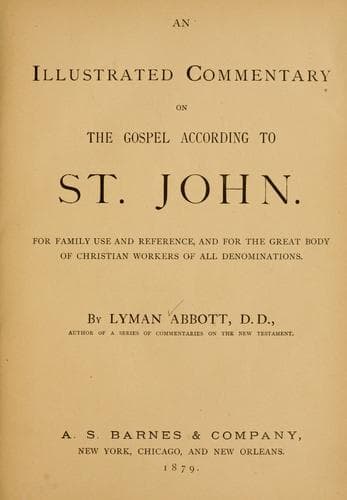
An illustrated commentary on the Gospel according to St. JohnAbbott, Lyman
Religion
An illustrated commentary on the Gospel according to St. John
Abbott, Lyman
Bible. John -- Commentaries
11 He[36] came unto his own, and his own received him
not.
[36] Acts 3:26; 13:46.
=10, 11.= Notice the rhetorical climax in these verses; he _was in_
the world; he _came_ unto his own; the world _knew_ him not; his
own _received_ him not. The _world_ is here humanity in general,
Jew and Gentile, both of whom united in Christ’s crucifixion; the
Jew, represented in the high-priest who deliberately rejected him
(John 11:47-50), the Gentile, represented in Pilate and the
soldiers, who simply did not know him. _His own_ are the Jewish
people, Jehovah’s peculiar possession (Exod. 19:5; Deut. 7:6;
Psalm 135:4; Isaiah 31:9), to whom he first came and by whom he
was rejected before he was preached to the Gentiles (Acts 13:46;
Rom. 1:16). It was only the world of _men_ that knew him not;
nature knew and obeyed him whenever he commanded her obedience, as
in the turning of water into wine, the stilling of the tempest, etc.
The verbs in this sentence are in the imperfect tense, and the
reference is to the incarnation of Christ and his earthly life. Observe
that the Jewish nation which rejected the Messiah is rejected by God
(Matt. 8:12), and that the disciples of Christ are not to know
the world which knew not their Lord and Master (1 John 2:15-17).
12 But as many[37] as received him, to them gave he power
to become the sons of God, _even_ to them[38] that believe
on his name:
[37] Isa. 56:4, 5; Rom. 8:14, 15; 1 John 3:1.
[38] Gal. 3:26.
Public-domain text, read in full here on John Shaqi.
Reviews
Reviews
No reviews yet
Be the first to share your thoughts on this work.
Elsewhere in the archive
Join the Discussion
Join the discussion
Sign in to leave a comment or review.
Sign InorCreate an account