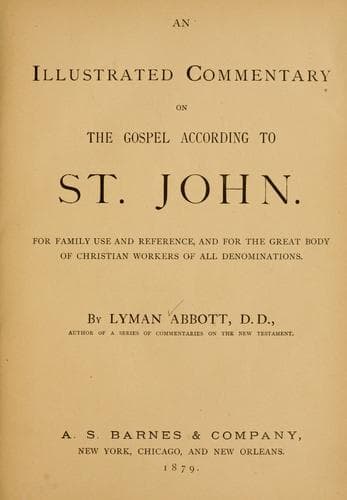
An illustrated commentary on the Gospel according to St. JohnAbbott, Lyman
Religion
An illustrated commentary on the Gospel according to St. John
Abbott, Lyman
Bible. John -- Commentaries
=12. But as many as received him.= Not merely, as Alford, “recognized
him as that which he was--the Word of God and Light of men,” but
_received him_ as the Word to be implicitly obeyed (ch. 14:21;
15:10, 15), and the Light in which to walk (1 John 1:6).--=To
them gave he power= (ἐξουσίαν). Not _capability_, nor _privilege_,
nor _claim_, but _power and right_; the original word combines the two
ideas. He confers the _power_ to become the sons of God, and confers
the _right_ to claim that privilege. Ryle is certainly correct in
saying that this verse “does not mean that Christ confers on those who
receive him a spiritual and moral strength, by which they convert
themselves, change their own hearts, and make themselves God’s
children.” He is as certainly wrong in saying, with Calvin and the
marginal reading, that the original Greek word means “right or
privilege.” The reader will best get its meaning by comparing John’s
use of it in other passages, in no one of which could it be rendered
either “right” or “privilege.” See ch. 5:27; 10:18; 17:2; 19:10, 11.
Comp. Matt. 28:18, note. The plain implication here is that the
_power_ to become a son of God is not natural and inherent, but
acquired, and is the especial gift of God. See Phil. 2:12, 13; Titus
3:4, 5.--=To become the sons of God.= Sons and therefore (1) partakers
of the divine nature (Ephes. 4:13; Heb. 12:10; 2 Pet. 1:4); (2)
entitled to and walking in freedom as children, not in bondage as
servants (ch. 15:15; Gal. 4:1-7); (3) heirs of God and joint-heirs
with Christ, his only-begotten Son (Rom. 8:16, 17). But the full
conception of the meaning of this sonship we cannot know, till in the
other world we see the Father as he is (1 John 3:1, 2).--=Even to them
that have faith in his name.= His name is _Jesus_, _i. e._, Saviour,
given to him because he saves his people from their sins (Matt. 1:21).
To have faith in that name is to have faith in him as a personal
Saviour from sin. Observe, then, that this verse comprises the whole
Gospel in a sentence. It declares (1) the object of the Gospel: that
we who are by nature the children of disobedience and of wrath (Ephes.
2:2, 3) may become the sons of God; (2) the source to which we are to
look for this prerogative of sonship: _power_ conferred by God; (3)
the means by which we are to attain it: personal faith in a personal
Saviour from sin. Observe too that John follows his description of the
rejection of Christ, not by threatening punishment to them, but by
depicting the infinite gain of those that accept Christ.
13 Which were born,[39] not of blood, nor of the will of
the flesh, nor of the will of man, but of God.
[39] James 1:18.
Public-domain text, read in full here on John Shaqi.
Reviews
Reviews
No reviews yet
Be the first to share your thoughts on this work.
Elsewhere in the archive
Join the Discussion
Join the discussion
Sign in to leave a comment or review.
Sign InorCreate an account