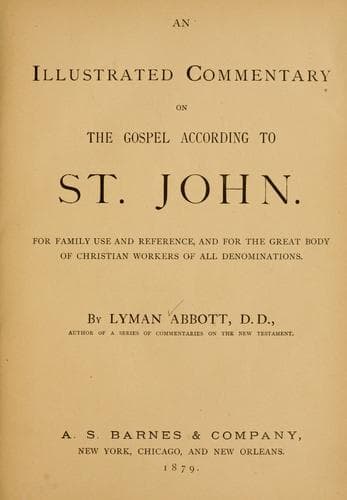
An illustrated commentary on the Gospel according to St. JohnAbbott, Lyman
Religion
An illustrated commentary on the Gospel according to St. John
Abbott, Lyman
Bible. John -- Commentaries
=13. Not of blood, nor of the will of the flesh, nor of the will of
man, but of God.= That is, not by inheritance (Luke 3:8); nor by
resolution (Rom. 8:5-8); nor by human teaching (1 Cor. 3:6, 7); but by
the direct personal influence and contact of the Spirit of God on the
heart (Titus 3:5, 6). Thus, John emphasizes the declaration of the
preceding verse, that _God gives the power to become the sons of God_,
by declaring that Christian character is not the product of either
good parentage, a strong will, or a good education, but directly of a
divine recreative act. (Gal. 6:15.) The Greek student will observe
that the preposition used is _of_ (ἐκ), not _through_ (διά); the
writer is speaking of the _origin_ or _source_ of Christian character,
not of the _instruments_ by which it is developed. Good parentage,
will power, and education, are all _means_ for the development of
divine sonship; the original cause, without which a true son of God is
never produced, is the creative act of God himself.
14 And the Word[40] was made flesh, and dwelt among us,
(and[41] we beheld his glory, the glory as of the only
begotten of the Father,) full[42] of grace and truth.
[40] Luke 1:35; 1 Tim. 3:16.
[41] 2 Pet. 1:17; 1 John 1:1, 2.
[42] Ps. 45:2; Col. 2:3, 9.
=14. And the Word.= The self-manifesting God, as described in the first
verse.--=Became flesh.= Not _a man_ (ἄνθρωπος) nor _a body_ (σῶμα),
but _flesh_ (σάρξ). The word is one whose signification would probably
be best rendered to the English reader by the phrase _human nature_.
Though occasionally used in the N. T. of the literal and material flesh
(Acts 2:31), it almost always indicates man in his corporeal or
earthly nature, sometimes signifying the predominance of that over the
higher or spiritual nature, sometimes simply signifying this aspect of
his nature, without any indication of its corrupt tendencies. Here,
then, the declaration is that the Word became human nature; _how_ is
not indicated. The language gives no sanction to either of the two
principal theories of the incarnation; the first, that Christ _took
on_ human nature as something superadded to the divine, so carrying
through life a double nature, both divine and human; the second, that
he simply entered a human body and became subject to the limitations
which it imposed on him. _How the divine became human_ we must learn
elsewhere in the N. T., if the N. T. reveals it at all; but the
declaration here is explicit that the divine Word became human.--=And
tabernacled among us.= _Pitched his tent with us._ As God in the
wilderness dwelt for a time in the transitory tabernacle, so the Word
dwelt in the flesh, which is elsewhere in the N. T. compared to a
tabernacle (2 Cor. 5:1, 4; 2 Pet. 1:13, 14). As God dwelt subsequently
in the permanent Temple at Jerusalem, so the Word makes its permanent
abode in the soul of the believer, which is the _Temple_, not the
Tabernacle of God (ch.
Public-domain text, read in full here on John Shaqi.
Reviews
Reviews
No reviews yet
Be the first to share your thoughts on this work.
Elsewhere in the archive
Join the Discussion
Join the discussion
Sign in to leave a comment or review.
Sign InorCreate an account