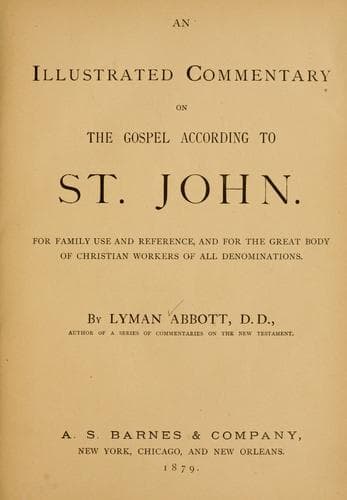
An illustrated commentary on the Gospel according to St. JohnAbbott, Lyman
Religion
An illustrated commentary on the Gospel according to St. John
Abbott, Lyman
Bible. John -- Commentaries
15:6, 7; 2 Cor. 6:16; Rev. 21:3). That the
reference here is to the incarnation, not to the spiritual presence of
Christ with the believer, is evident from the fact that the verb
(ἐσκίνωσεν) is in the historical tense. John says he _tabernacled_,
not he _tabernacles_, among us.--=And we beheld his glory, the glory
as of the only begotten from the Father.= We are made sons of God; but
Christ alone is the _only begotten Son_. For the meaning of this
phrase, see Luke 7:12; 8:42; 9:38. John uses it only of Jesus Christ.
The Greek student should observe the use of the preposition _from_
(παρά). It designates the source from which anything is derived, and
here indicates that in a peculiar sense Christ is from the Father,
directly and immediately; we are from him only through Christ. Comp.
ch. 7:29. In a peculiar sense the Apostles beheld Christ’s glory (ch.
2:11; Matt. 17:1-4; 2 Pet. 1:16; 1 John 1:1). But in Christ’s life and
character, and in their influence on the world, we are all beholders
of the true divine glory, manifested in him (Heb. 1:3); and his
earthly life is the brightness and glory of heaven (Rev. 21:23; 5:9,
10). The language, _as of the only begotten_, distinguishes the glory
of Christ from that of all previous revealers of the divine will and
nature. Since many of the prophets too were glorified, as Moses,
Elijah, and Elisha, the one encircled by the fiery chariot, the other
taken up by it; and after them Daniel and the three children, and the
many others who showed forth wonders; and angels who have appeared
among men, and partly disclosed to beholders the flashing light of
their proper nature; and since not angels only, but even the cherubim
were seen by the prophet in great glory and the seraphim also; the
Evangelist, leading us away from all these, and removing our thoughts
from created things, and from the brightness of our fellow-servants,
sets us at the very summit of good. For, “not of prophets,” says he,
“nor angel, nor archangel, nor of the higher powers, nor of any other
created nature, if other there be, but of the Master himself, the King
himself, the true only begotten Son himself, of the very Lord of all,
did we _behold the glory_.”--(_Chrysostom._)--=Full of grace and
truth.= There is some doubt whether this is said of the _glory_
beheld, or of the _only begotten Son_ whose glory was beheld. The
question is not very important; the latter construction is
grammatically preferable. Thus rendered, the clause “And we beheld,
etc.,” is parenthetical, John’s statement being: “The Word tabernacled
among us, full of grace and truth.” Observe (1) that the _grace_ here
answers to the _Life_ in verse 4, and the _truth_ to the _Light_ in
verse 9. Because of his grace Christ is Life to all who accept him;
because of his truth he is Light to all who follow him; (2) that the
declaration here is explained by, and is possibly partially derived
from Exodus 33:18, 19, where Moses asks to see God’s glory, and is
Public-domain text, read in full here on John Shaqi.
Reviews
Reviews
No reviews yet
Be the first to share your thoughts on this work.
Elsewhere in the archive
Join the Discussion
Join the discussion
Sign in to leave a comment or review.
Sign InorCreate an account