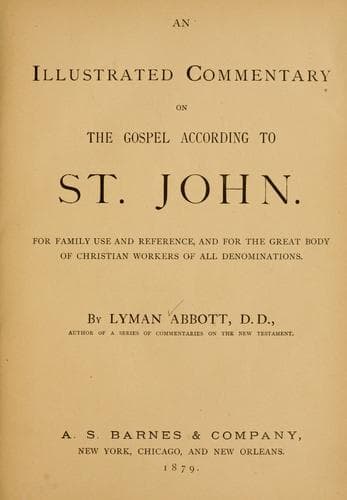
An illustrated commentary on the Gospel according to St. JohnAbbott, Lyman
Religion
An illustrated commentary on the Gospel according to St. John
Abbott, Lyman
Bible. John -- Commentaries
promised a disclosure of the divine _goodness_; in the goodness of God
in Christ Jesus we behold the divine glory; (3) that the Christian is
to be, like his Master, full of grace _and_ truth, and that to be at
once perfectly truthful and also gracious is one of the most difficult
practical problems of the Christian life (Rom. 12:9). It seems to me
clear that John has in mind throughout this verse the manifestation of
the glory of God, through the Shechinah, in the Tabernacle, and
subsequently in the Temple (Exod. 40:34, 35; 1 Kings 8:10; see Matt.
17:5, note). As the Shechinah made luminous and glorious these earthly
dwelling-places, so the Word, by his indwelling, made glorious the
flesh.
15 John[43] bare witness of him, and cried, saying,
This was he of whom I spake, He that cometh after me is
preferred before me: for he was before me.
[43] Matt. 3:11, etc.
=15. John is testifying concerning him.= John the Baptist was long
since dead when these words were written; but his testimony was
not dead; it was an ever-living testimony. The verb is therefore
put in the present tense, not, as in our English version, in the
past.--=And he cried, saying,= It is the echo of this cry which still
resounds and witnesses to Jesus Christ. The language used implies a
public testimony, and one borne with confidence and joy. On seeing
the Christ of whom he had prophesied, John the Baptist _cries out_,
“This is he of whom I spoke.” For illustration of John’s prophetic
utterances concerning the Messiah, previous to the baptism of Jesus,
see Matt. 3:11, 12; Mark 1:7, 8.--=He that cometh after me.= Christ
did not begin his public ministry till the imprisonment of John the
Baptist (Mark 1:14). Thus as a public teacher he came after John the
Baptist.--=Came forth before me.= Not, _was before me_ (γίγνομαι has
not the force of εἰμί), for then the sentence would be tautological--
that Jesus _was_ before John is in the next clause given as the
_reason_ for the statement in this, that he came forth before him; nor
can the meaning be _was preferred before me_, in the sense of esteemed
above me, for the mere fact of Christ’s pre-existence would be no
reason for esteeming him more highly than John--the devil _existed_
before John the Baptist; nor, _was preferred before me_, in the sense
of, was exalted in rank above me, though some excellent scholars, _e.
g._, Alford, Olshausen, De Wette, so interpret it; but, as I have
rendered it above, _came forth_, or, _was set before me_. The
reference is to the previous manifestations of the Word, in the
partial revelations of God in the O. T. All the disclosures of the
divine nature in the O. T. were made through the Word or utterance of
God, through whom alone he speaks to the human race. See ver. 4, note,
and ch. 8:56-58. John then says “He who is coming after me is the One
who has already come forth before me; for he existed before me.”
Public-domain text, read in full here on John Shaqi.
Reviews
Reviews
No reviews yet
Be the first to share your thoughts on this work.
Elsewhere in the archive
Join the Discussion
Join the discussion
Sign in to leave a comment or review.
Sign InorCreate an account