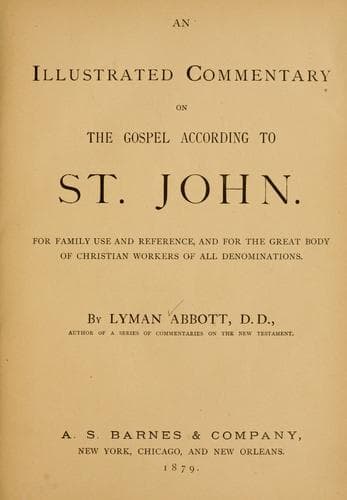
An illustrated commentary on the Gospel according to St. JohnAbbott, Lyman
Religion
An illustrated commentary on the Gospel according to St. John
Abbott, Lyman
Bible. John -- Commentaries
Christ’s pre-existence would not explain the preference, either in the
divine love or in rank, but it does in part explain precedence in
appearance or manifestation. So Hengstenberg, “My successor is my
predecessor.”
16 And of his fulness[44] have all we received, and grace
for grace.
[44] ch. 3:34.
=16. And of his fullness have we all received.= The _fullness_ is
that of the divine nature, of which we are made partakers through
faith in Christ (Col. 1:19; 2:9, 10; Ephes. 3:19). The _all_
are those who receive him and thus become the sons of God (verse
12). This and the two following verses are the addition of the
Evangelist, not the continuance of John the Baptist’s discourse;
this is evident both from their style, which better accords with
that of the Evangelist, and because the _fullness_ of Christ’s
nature was not received by John the Baptist and his disciples, for
it was not disclosed till after the Baptist’s death. Observe, (1)
How inexhaustible the fountain. From Christ’s fullness all spiritual
life is supplied. Chrysostom compares Christ to a fire from which ten
thousand lamps are kindled, but which burns as brightly thereafter
as before. “The sea is diminished if you take a drop from it, though
the diminution be imperceptible; but how much soever a man draw from
the divine Fountain, it continues undiminished.” (2) How free the
supply; we have _all_ received. “None went empty away.”--(_Meyer._)
(3) The nature of Christian experience. It is not a mere trust in
a crucified Saviour for pardon for the past; it is also a personal
and continuous receiving of divine life from the fullness of a
living Saviour.--=And grace for grace.= Of this expression there are
two interpretations. The ancient expositors understood it to
mean, For the lesser grace of the O. T. we have received the greater
grace of the N. T. So Chrysostom: “There was a righteousness and
there is a righteousness (Rom. 1:17); there was a glory and there is a
glory (2 Cor. 3:11); there was a law and there is a law (Rom. 8:2);
there was a service and there is a service (Rom. 9:4; 12:11); there
was a covenant and there is a covenant (Jer. 31:31, 32); there was a
sanctification and there is a sanctification; there was a baptism and
there is a baptism; there was a sacrifice and there is a sacrifice;
there was a temple and there is a temple; there was a circumcision and
there is a circumcision; and so too there was a grace and there is a
grace.” The modern commentators, Alford, Meyer, Lange, etc.,
understand it to mean, “For each new accessory of grace we receive a
still larger gift. Each grace, though, when given large enough, is, as
it were, overwhelmed by the accumulation and fullness of that which
follows.”--(_Bengel._) “Grace for grace, grace _in the place_ of
that which preceded--therefore grace uninterrupted, unceasingly
renewed.”--(_Winer._) The spiritual signification of the passage is
substantially the same on either interpretation. We have nothing to
Public-domain text, read in full here on John Shaqi.
Reviews
Reviews
No reviews yet
Be the first to share your thoughts on this work.
Elsewhere in the archive
Join the Discussion
Join the discussion
Sign in to leave a comment or review.
Sign InorCreate an account