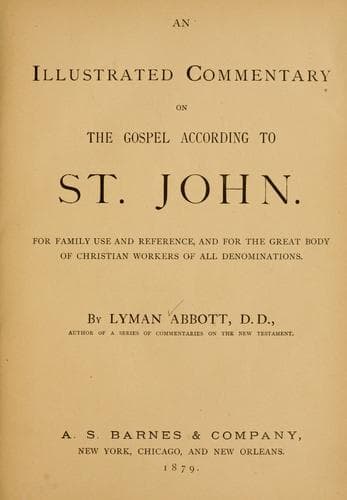
An illustrated commentary on the Gospel according to St. JohnAbbott, Lyman
Religion
An illustrated commentary on the Gospel according to St. John
Abbott, Lyman
Bible. John -- Commentaries
give in exchange for the divine grace; our only virtue is to receive.
It is given to us in exchange for the grace already imparted. “Unto
every one that hath shall be given;” but what he already hath is God’s
gift, which bestows both the good and the purchase money, each new
gift superseding the old, as the N. T. gift of grace and truth through
Jesus Christ superseded the lesser gift of law through Moses. With
this accords the teaching of both O. T. and N. T. See, for example,
Deut. 7:7; Ps. 6:4; 23:3; 25:7; 31:16; 79:9; 115:1; Isaiah 55:1;
Ephes. 2:4; 1 John 4:8, 10.
17 For the law was given by Moses, _but_ grace[45] and
truth came by Jesus Christ.
[45] Ps. 85:10; Rom. 5:21.
=17. For the law was given by Moses.= _Through_ (διὰ) Moses as the
instrument or mediator of the old covenant.--=Grace and truth came by
Jesus Christ.= _Through_ (διὰ) Jesus Christ as the mediator of the new
covenant. The _grace_ is the favor of God (see below), the _truth_ is
the clear revelation of the divine character and will, seen only dimly
under the old covenant. (2 Cor. 3:13, 14.) Observe the contrast
between Christ and Moses (comp. Heb. 3:5, 6); and between the
gifts brought by the two. The law _was given_, a completed thing, once
for all; _grace and truth_ came and continually come, grace for grace,
out of the inexhaustible fullness of the giver.
ON THE MEANING OF THE WORD “GRACE.” The word here translated _grace_
(χάρις) is also variously translated in the N. T. _acceptable_,
_benefit_, _favor_, _gift_, _joy_, _liberality_, _pleasure_, _thanks_,
and _thankworthy_. This fact will of itself sufficiently indicate that
the word possesses various shades of meaning. They are all, however,
etymologically derived from the same root idea. The noun is derived
from a verb meaning to rejoice, and primarily signifies that which
gives joy to another. With the Greeks, beauty was one of the chief
joys; hence the first meaning of the word--grace of external form,
manner, or language, a meaning which it but rarely bears in the N. T.
(see Luke 4:22; Col. 4:6). Thence it derived a deeper meaning, viz.,
beauty in character, and this, according to the N. T. teaching, is
good-will, the disposition to do a kindness to another, to make
another rejoice; hence the word is used to signify that quality in God
which leads him to confer freely happiness on men, either on special
individuals (Luke 2:40; 1 Cor. 3:10), or on the whole human race (Rom.
3:24; Ephes. 1:6; Tit. 2:11). Thence it was employed to designate the
kindness actually flowing from and conferred by this disposition,
hence an alms, and in the N. T. the spiritual gifts conferred by the
divine love on the soul (1 Cor. 16:3; 2 Cor. 8:4; 1 Cor. 15:10; 2 Cor.
6:1; 2 Pet. 3:18); in which sense it is employed in the apostolic
benediction (1 Cor. 1:3; 2 Cor. 1:2; Gal. 1:3, etc.). Finally it was
used to designate the feeling awakened by favors shown, the reflection
Public-domain text, read in full here on John Shaqi.
Reviews
Reviews
No reviews yet
Be the first to share your thoughts on this work.
Elsewhere in the archive
Join the Discussion
Join the discussion
Sign in to leave a comment or review.
Sign InorCreate an account