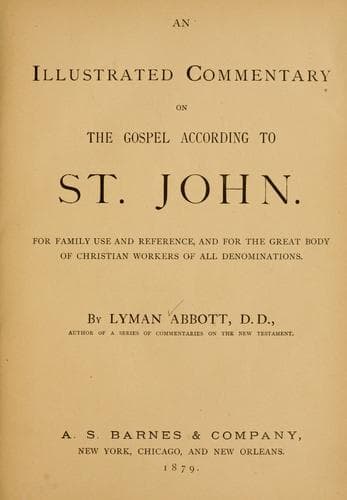
An illustrated commentary on the Gospel according to St. JohnAbbott, Lyman
Religion
An illustrated commentary on the Gospel according to St. John
Abbott, Lyman
Bible. John -- Commentaries
ANCIENT BREAD 236
THE GOSPEL ACCORDING TO JOHN.
INTRODUCTION.
From the beginning of the third century to near the close of the
seventeenth, the Fourth Gospel was by a common and substantially a
unanimous consent attributed to the Apostle John. This authorship was
then questioned, at first by an English critic by the name of Evanson.
The discussion was soon transferred to Germany, where it waxed warm,
and whence it was again transferred to England and this country.[1] It
may now be regarded as the most hotly contested question in biblical
criticism. The controversy has been intensified by prejudices and
feeling on both sides. It is indeed impossible to discuss it with cool
indifference, as a mere matter of curious literary interest. If this
Gospel was written by the Apostle John, we have the testimony of an
undoubted eye-witness--not his conclusions but his account of facts
in respect to which he could not well be deceived--certainly not,
unless we are prepared to believe that Jesus was himself a deliberate
deceiver; testimony of an eye-witness whose honesty not even the
most resolute skepticism would or could well call in question. This
testimony would establish beyond question such facts as the miraculous
feeding of the five thousand, the healing of the man born blind, the
resurrection of Lazarus, and the death and resurrection of Jesus
himself. In other words, it would establish beyond the possibility of
reasonable question, the truth of historical Christianity. Accordingly,
Renan, who to a certain extent accepts the authenticity of the Fourth
Gospel, is compelled to maintain that the pretended resurrection of
Lazarus was a pious fraud to which Jesus lent himself because it was
necessary to the success of his mission, and because his growing
religious enthusiasm justified to his conscience this means, for the
sake of the end to be accomplished by it. Moreover, we have in this
Gospel a report of words of Jesus, which leave to us no alternative
but to accept him as in a peculiar sense the Son of God, or to regard
him either as a religious impostor or a religious enthusiast. The
synoptics leave some opportunity for discussion as to the place which
Jesus assumed to fill. The Fourth Gospel does not. Thus the question
of the authorship of this Gospel is not merely a question in literary
criticism, but even more one respecting the nature of Christianity.
Accordingly we find, on the one hand, the advocates of its apostolic
authorship more or less resting their belief upon the inherent beauty
of the book, and the opponents more or less declaring the true ground
of their opposition to it, viz., that it presents what they call a
mythological view of Jesus, and a dogmatic view of his teachings; in
other words, that it presents Jesus distinctively as the incarnate
Son of God, and represents the central truth in his teaching to have
Public-domain text, read in full here on John Shaqi.
Reviews
Reviews
No reviews yet
Be the first to share your thoughts on this work.
Join the Discussion
Join the discussion
Sign in to leave a comment or review.
Sign InorCreate an account