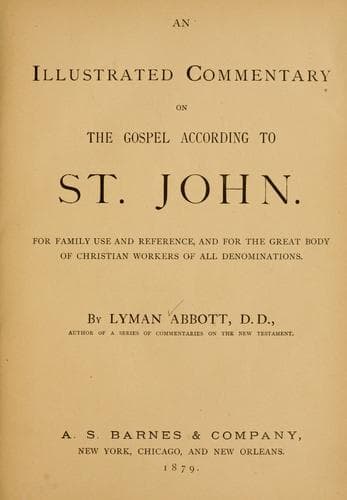
An illustrated commentary on the Gospel according to St. JohnAbbott, Lyman
Religion
An illustrated commentary on the Gospel according to St. John
Abbott, Lyman
Bible. John -- Commentaries
=24-27. And they which were sent were of the Pharisees.= The Pharisees
were scrupulous ceremonialists, and ablutions were an important part of
their ceremonial. See Matt. 15:1-7; Mark 7:2-5, notes. To them John’s
employment of baptism appeared irregular and unauthorized if he were
not invested with some special divine authority.--=John answered
them.= This answer is only indirectly responsive to their
interrogatory. He passes at once from his own authority, which he
disdains to defend, to testify to the Messiah, whose forerunner he is.
The synoptical Evangelists (Matt. 3:11, 12, note; Mark 1:7, 8; Luke
3:16, 17) report more fully John’s characterization of his own baptism
and its contrast with that which the Messiah would inaugurate; one in
water, the other in fire and the Holy Ghost; one a symbol, the other
the thing symbolized; one a prophecy, the other its fulfillment.--=There
standeth one among you whom ye know not.= That is, do not recognize as
what he really is, the Messiah. It is not necessarily implied that
Jesus Christ was present at this interview, and verse 29 implies that
he was not. The language simply points to one apparently of the common
people and unknown.--=Who cometh after me, whose shoe-latchet I am
unworthy to unloose.= This is the true reading; the words _is
preferred before me_ have been added by some copyist from verse 15. On
the significance of the expression, see notes on Matt. 3:11 and Luke
3:16. The latchet of the shoe is the leather thong with which the
sandal was bound on to the foot or the shoe was laced. For
illustration, see Mark 6:7-13, Vol. 1, p. 362.
28 These things were done in Bethabara[52] beyond Jordan,
where John was baptizing.
[52] Judges 7:24.
=28. Bethabara.= The best reading here is Bethany; the common reading,
Bethabara, is derived from Origen, who found such a place about
opposite Jericho. The Bethany intended is certainly not the well-known
town of that name on the eastern slope of the Mount of Olives, for this
one was beyond Jordan. The site is unknown; it has been fixed by Origen
as far south as Jericho; by Stanley, 30 miles north of Jericho, near
Succoth; by Lightfoot, north of the Sea of Galilee. We can only say
that it was probably at one of the fords of the Jordan, in the great
eastern line of travel, and certainly at some point between the sea
of Galilee and the neighborhood of Jericho. There are two traditional
sites, one Greek, the other Latin, and both historically worthless.
29 The next day John seeth Jesus coming unto him, and
saith, Behold the Lamb[53] of God, which taketh[54] away
the sin of the world.
[53] Ex. 12:3; Isa. 53:7, 11; Rev. 5:6.
[54] Acts 13:39; 1 Pet. 2:24; Rev. 1:5.
Public-domain text, read in full here on John Shaqi.
Reviews
Reviews
No reviews yet
Be the first to share your thoughts on this work.
Elsewhere in the archive
Join the Discussion
Join the discussion
Sign in to leave a comment or review.
Sign InorCreate an account