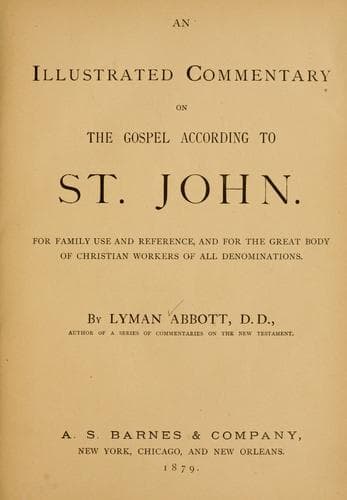
An illustrated commentary on the Gospel according to St. JohnAbbott, Lyman
Religion
An illustrated commentary on the Gospel according to St. John
Abbott, Lyman
Bible. John -- Commentaries
=29. The next day.= Not merely, _some following day_, for the original
Greek word (ἐπαύριον) never has this meaning in the N. T. It has been
so rendered by some commentators here, in order to introduce the
Temptation between the testimony of the Baptist to the delegation from
Jerusalem and his testimony here uttered to his own disciples.--=He
seeth Jesus.= The word _John_ has been inserted by some copyists to
make the meaning clearer.--=Coming toward him.= Not, as in our English
version, _unto him_. The preposition employed (πρός) signifies simply
direction. Why he was coming toward him is not a matter for profitable
conjecture. Not, as some suppose, for baptism, for the temptation
followed the baptism, and the order of events in John’s narrative
follow each other so closely up to and after the marriage at Cana
(vers. 35, 43; ch. 2:1), that no time is afforded for the temptation,
which was forty days in duration, and which must have occurred prior
to the interview between the Baptist and the Jewish delegation.--=And
said.= Publicly, probably to his own disciples, perhaps to the
multitude. This first preaching of Christ produced no observable
effect. It was not till John repeated it on the following day (ver.
37) that any of his auditors followed Jesus.--=Behold the Lamb of
God.= Not _a_ lamb of God. The meaning cannot therefore be, Behold a
pure and innocent man; an interpretation which would probably never
have been conceived, but for the purpose of escaping the doctrine of
atonement for sin, which can be escaped only by rejecting both the Old
and the New Testaments in their entirety.--=Which taketh away.= This
exactly represents the significance of the original verb (αἴρω), which
means, not bears, or suffers, or releases from the penalty of, but
_takes away_. For its non-metaphorical use, see Matt. 13:12, _shall be
taken away_; 21:21, _be removed_; Luke 6:30, _that taketh away_ thy
goods; John 11:39, _take away_ the stone; 11:48, the Romans shall
_take away_ both our place, etc. It thus corresponds almost exactly
with the word (ἁφίηγι) ordinarily translated forgive. See Matt. 6:12,
note. Observe that the verb is in the present tense, _is taking away_.
The sacrifice has been offered once for all; but its effect is a
continuous one. Christ is ever engaged in lifting up and taking away
the sin of the world.--=The sin of the world.= Not _sins from the
world_, which would be a very different matter. The sin is represented
as _one burden_, which Christ _as a whole_ lifts up and carries away.
His redemption is not a limited redemption; it provides a finished
salvation for the entire human race. See ch. 16:22, note.
Public-domain text, read in full here on John Shaqi.
Reviews
Reviews
No reviews yet
Be the first to share your thoughts on this work.
Elsewhere in the archive
Join the Discussion
Join the discussion
Sign in to leave a comment or review.
Sign InorCreate an account