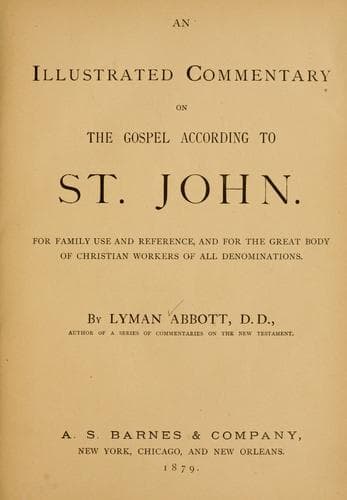
An illustrated commentary on the Gospel according to St. JohnAbbott, Lyman
Religion
An illustrated commentary on the Gospel according to St. John
Abbott, Lyman
Bible. John -- Commentaries
Very unnecessary difficulty has been made respecting the interpretation
of the Baptist’s simple metaphor here. The lamb was throughout the O.
T. times commonly used for sacrifice as a sin-offering (Lev. 4:32); in
cleansing the leper (Lev. 14:10); at the morning and evening sacrifice
(Exod. 29:38); at all the great feasts (Numb. 28:11; 29:2, 13, 37;
Lev. 23:19); and in large numbers on special occasions (1 Chron.
29:21; 2 Chron. 29:32; 35:7). The sacrifice of the paschal lamb at the
Passover connected the lamb as a sacrifice with the greatest feast day
of the nation, and with the national redemption from bondage and
deliverance from death (Exod. 12:21-27). The ceremony with the
scape-goat on the day of atonement, the only fast-day in the Jewish
calendar, interpreted clearly, and by an annual symbol, the meaning of
these sacrifices. On that day two kids of goats were chosen, closely
resembling each other; one was slain as a sin-offering; over the other
the high-priest confessed the sins of the people, “putting them on the
head of the goat,” who was then led away into the wilderness, “to bear
upon him all their iniquities unto a land not inhabited” (Lev.
16:5-10, 20-22). Isaiah, with unmistakable reference to these typical
sacrifices, declared that the Messiah should bear the sins and sorrows
of the world as a lamb slaughtered (Isaiah 53:1-7); and the Baptist,
speaking to a people whose national education had led them to regard
the lamb as the type of sacrifice, through the shedding of whose blood
there was a redemption, a carrying away of sins, points to Jesus with
the declaration, Behold _the_ Lamb of God that taketh away the sin of
the world, that is, the true Sin-bearer, of whom all that went before
were but types and prophecies. _How_ he was to take away this load of
sin the Baptist does not say, and probably did not know. That he did
not realize that Christ was to be a true sacrifice for sin is
indicated by his subsequent perplexity and message to Jesus (Matt.
11:2-6, note). Observe the analogy and the contrast between the O. T.
and the N. T. Under the O. T. there were provided by the sinner lambs,
whose sacrifice took sin away from the individual or the nation, but
for the time only, and therefore the sacrifice needed to be
continually repeated; under the N. T. _one_ Lamb is provided, the Lamb
of God, _i. e._, proceeding from and _provided by God_, as intimated
by Abraham to Isaac (Gen. 22:8), whose sacrifice _once for all_ (Heb.
10:10-12) takes away the sin of the _whole world_ (1 John 2:2), and
therefore never needs to be repeated. It is worthy of note that the
word _lamb_ is never used in the N. T. except in reference to Jesus
Christ (John 1:29, 36; Acts 8:32; 1 Peter 1:19; Rev. 5:6, 8, 12,
etc.). The word _lambs_ in the plural form occurs twice, but both
times refer to the disciples of Christ (Luke 10:3; John 21:15).
30 This is he of whom I said, After me cometh a man which
is preferred before me: for he was before me.
Public-domain text, read in full here on John Shaqi.
Reviews
Reviews
No reviews yet
Be the first to share your thoughts on this work.
Elsewhere in the archive
Join the Discussion
Join the discussion
Sign in to leave a comment or review.
Sign InorCreate an account