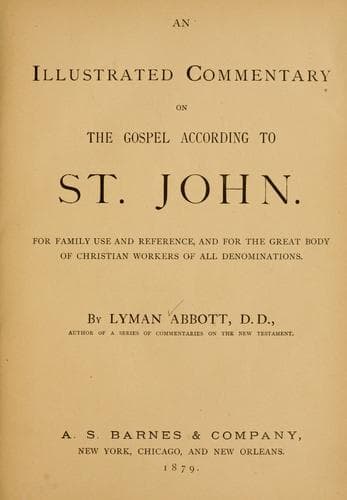
An illustrated commentary on the Gospel according to St. JohnAbbott, Lyman
Religion
An illustrated commentary on the Gospel according to St. John
Abbott, Lyman
Bible. John -- Commentaries
furnishes a model to all disputants in dealing with religious
prejudice. See 2 Tim. 2:24.
47 Jesus saw Nathanael coming to him, and saith of him,
Behold[60] an Israelite indeed, in whom is no guile!
[60] Ps. 32:2; Rom. 2:28, 29.
48 Nathanael saith unto him, Whence knowest thou me? Jesus
answered and said unto him, Before that Philip called thee,
when thou wast under the fig tree, I saw[61] thee.
[61] Ps. 139:1, 2.
49 Nathanael answered and saith unto him, Rabbi, thou[62]
art the Son of God; thou art the King[63] of Israel.
[62] chap. 20:28, 29; Matt. 14:33.
[63] Matt. 21:5; 27:11.
=47-49. An Israelite indeed.= Because in faith and love a true child
of God. Comp. Luke 19:9; Romans 2:28, 29; Gal. 3:29; 6:15, 16. For O.
T. description of such an Israelite, see Psalm 15.--=In whom is no
guile.= Therefore, characteristically unlike the Pharisees, whose
pride it was that they were children of Abraham (Luke 3:8; John 8:33),
and who were full of hypocrisy (Matt. 6:2, 5, 16; 23:14-33).--=Whence
knowest thou me?= As Saul of Tarsus (Acts 9:5, 6, notes), so Nathanael
is surprised by the Lord’s reading of his character and inward
experience.--=When thou wast under the fig-tree.= The whole course of
the narrative indicates in this response a supernatural sight, as in
the previous characterization of Nathanael a supernatural insight. If
Christ had merely chanced to see Nathanael without being seen by him,
this fact would afford, surely, no basis for Nathanael’s faith, or
Christ’s commendation of it. It seems also clear that something more
is implied than the mere fact that Christ saw Nathanael under a
fig-tree, since that would neither explain Christ’s commendation of
him as an Israelite without guile, nor Nathanael’s astonishment. Hence
the surmise of the commentators that he had retired there for purposes
of prayer, and that Christ had seen him there, like the Israel from
whom he descended (Gen. 32:24-23) wrestling with God, for the bestowal
of the long-promised blessing to his realm, in the gift of the
Messiah. It was probably this revelation of the secret of his soul
which caused Christ to characterize him as a true Israelite, and
Nathanael to recognize in the One who read his inmost life so
perfectly, the King of Israel.--=The Son of God * * * the King of
Israel.= The Messiah. See Ps. 2:7; Matt. 16:16; Luke 22:70;
John 1:34; 11:27. Observe that Christ recognizes and accepts this
characterization of himself at the outset of his ministry, a quite
sufficient refutation of the theory of Renan, that it was the
outgrowth of his followers’ later admiration, and tacitly accepted by
Christ at or near the close of his earthly life. That Nathanael fully
comprehended the meaning of his own confession is not, however,
probable.
Public-domain text, read in full here on John Shaqi.
Reviews
Reviews
No reviews yet
Be the first to share your thoughts on this work.
Elsewhere in the archive
Join the Discussion
Join the discussion
Sign in to leave a comment or review.
Sign InorCreate an account