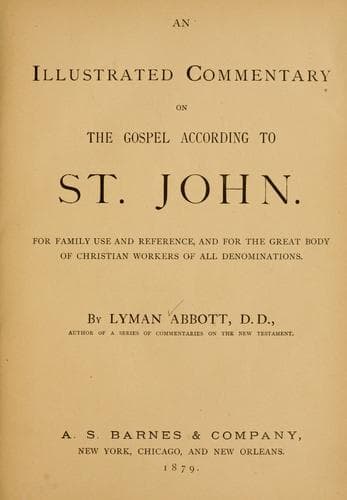
An illustrated commentary on the Gospel according to St. JohnAbbott, Lyman
Religion
An illustrated commentary on the Gospel according to St. John
Abbott, Lyman
Bible. John -- Commentaries
references in the books of Moses to the promised Messiah, see Gen.
3:15 and 17:7, with Gal. 3:16, and Deut. 18:15-19.--=Jesus of
Nazareth, the son of Joseph.= This is the language, not of the
Evangelist, but of Philip. Unquestionably at that time Philip knew
nothing of the supposed birth of Jesus; to him Jesus was, as to the
Nazarenes subsequently (Matt. 13:54-56), simply the son of Joseph. The
supposed inconsistency of this language and the account of Christ’s
supernatural birth as given by Matthew, is therefore purely imaginary.
46 And Nathanael said unto him,[59] Can there any good
thing come out of Nazareth? Philip saith unto him, Come and
see.
[59] chap. 7:41.
=46. Out of Nazareth is it possible that anything good can come!=
There is a scornful emphasis on the word Nazareth not preserved in our
English version. That Nazareth was an unimportant and insignificant
town is indicated by the fact that it is neither mentioned in the O.
T. nor in Josephus; that the moral condition of its inhabitants was
below that of the rest of Galilee is indicated by the declaration of
Mark 6:5, 6, and by the mob which threatened the life of Christ at a
time when he was just growing into popularity elsewhere in Galilee
(Luke 4:28-30). No other definite reason is known for the evident
odium which attached to Nazareth even in the minds of Galileans. Comp.
Matt. 2:23, note. The question of Nathanael furnishes a striking
illustration of the spirit of prejudice in even good men. To Nathanael
it seems impossible that the promised Prophet can appear elsewhere
than in or near the city of the Great King.--=Come and see.= This is
the best answer to make to unbelief. Christ is his own best witness
(ch. 5:34). It is not merely true that “personal experience is the
best test of the truth of Christianity, which, like the sun in heaven,
can only be seen in its own light” (_Schaff_), but it is also true
that Christ is a greater miracle than any he ever wrought; and that
the supreme character of Christ carries in itself a moral conviction
to hearts which resist all arguments drawn from nature. Of this truth
John Stuart Mill, in his Three Essays on Religion, affords a striking
illustration. After considering all the arguments for the existence
and perfection of the Divine Being derived from nature, and declaring
that Natural Religion points to a Being “of great but limited power,”
“who desires and pays some regard to the happiness of his creatures,
but who seems to have other motives of action which he cares more
for,” he comes to the character of Christ, and not only pays a tribute
to it, eloquent and reverent, but adds his conviction that it would
not “even now be easy, even for an unbeliever, to find a better
translation of the rule of virtue from the abstract into the concrete,
than to endeavor so to live that Christ would approve our life.”
Chrysostom notices the gentleness and candor of Philip’s reply; he
Public-domain text, read in full here on John Shaqi.
Reviews
Reviews
No reviews yet
Be the first to share your thoughts on this work.
Elsewhere in the archive
Join the Discussion
Join the discussion
Sign in to leave a comment or review.
Sign InorCreate an account