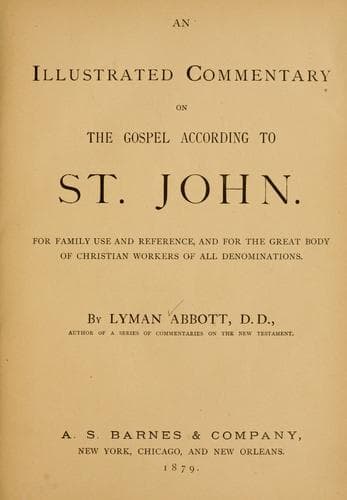
An illustrated commentary on the Gospel according to St. JohnAbbott, Lyman
Religion
An illustrated commentary on the Gospel according to St. John
Abbott, Lyman
Bible. John -- Commentaries
congruous and consistent, and are all embraced in the promise. Christ
opened the communication between earth and heaven; manifested that
fact by the angelic appearances which accompanied his coming, his
presence, and his departure; still manifests it, by the spiritual
blessings which he constantly confers in answer to the prayers of his
people; and will finally manifest it yet more gloriously when he comes
to take possession of his established kingdom, with his holy angels
with him. The past and present fulfillments of this prophecy are but
fragmentary and imperfect. The final and perfect fulfillment awaits us
in the future.
[Illustration: AN ORIENTAL WEDDING.
“_And the third day there was a marriage in Cana of Galilee_”]
CHAPTER II.
Ch. 2:1-11. THE MARRIAGE AT CANA IN GALILEE. CHRISTIANITY NOT
ASCETICISM.
This miracle is recounted only by the Evangelist John. That fact does
not discredit the account: it incidentally confirms the view that he
wrote to supply what was lacking in the other Gospels.
[Illustration: CANA OF GALILEE.]
1 And the third day there was a marriage in Cana[66] of
Galilee; and the mother of Jesus was there.
[66] ch. 4:46; Joshua 19:28.
2 And both Jesus was called, and his disciples, to the
marriage.[67]
[67] Heb. 13:4.
=1, 2. The third day.= That is, probably, after the interview with
Nathanael described at the close of the preceding chapter. Lightfoot
says that, according to Jewish custom, the weddings of virgins took
place on the fourth day of the week, our Wednesday, and of widows on
the fifth day, our Thursday.--=There was a marriage.= For description
of wedding ceremonies among the Jews, with illustration of wedding
procession, see Matt. 25:1-13, Prel. Note.--=In Cana of Galilee.= The
traditional site is Kefr Kenna, four and one-half miles northwest of
Nazareth. The more probable site is about nine miles north of Nazareth
and six or eight hours from Capernaum. See Map, Vol. I, p. 50.
Robinson describes it as a fine situation, and once a considerable
village of well-built houses. They are now uninhabited and the whole
region is wild and desolate.--=And the mother of Jesus was there.= Her
name is never mentioned by John. The fact that Joseph is not mentioned
in either of the Gospels, after Christ’s manhood, has led to the
universal opinion that he was dead. The presence of Mary, and her
apparent authority (ver. 5), indicates that the bride or bridegroom
were connections or relatives. Different traditions represent
respectively Alphæus, one of his sons, John the Apostle, and Simon the
Canaanite as the bridegroom, but they are all equally untrustworthy.
The Mormons maintain that this was the marriage of Jesus himself.The
student will observe that it is said of Mary that she _was there_, of
Jesus that he _was called_, an indication that he came at a later
period, and probably after the marriage feast, which usually lasted
Public-domain text, read in full here on John Shaqi.
Reviews
Reviews
No reviews yet
Be the first to share your thoughts on this work.
Elsewhere in the archive
Join the Discussion
Join the discussion
Sign in to leave a comment or review.
Sign InorCreate an account