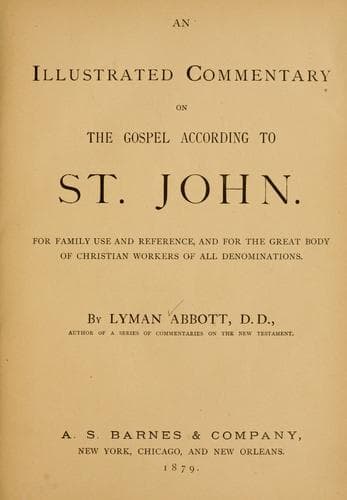
An illustrated commentary on the Gospel according to St. JohnAbbott, Lyman
Religion
An illustrated commentary on the Gospel according to St. John
Abbott, Lyman
Bible. John -- Commentaries
=9, 10. The ruler of the feast.= The same word as _governor of the
feast_, in the preceding verse. Among the Greeks and Romans, a ruler
of the feast (_symposiarch_) was commonly chosen, usually by lot, who
regulated the whole order of the festivities, proposed the amusements,
etc. A reference in the Apocrypha (Eccles. 32:1, 2) indicates that the
same practice prevailed among the Jews. There is no ground for
supposing the ruler of the feast in this case to have been other than
a guest, who occupied this honorary office.--=But the servants knew,
they having drawn the water.= Not merely, _the servants which drew,
knew_; the reason of their knowledge is indicated; they knew because
they had themselves filled the jars with the water, and drawn it
out.--=Called the bridegroom.= Called out to him, probably across the
table. The language which follows is sportive, and characteristic of
such an occasion of festivity.--=Every man at the beginning doth set
forth good wine; and when men are drunken, then that which is worse.=
The verb rendered in our English version “have well drunk” is
literally _are drunken_. It is in the passive voice. This does not
necessarily imply that in the East men counted on the inebriacy of
their guests, and for that reason provided the best wine first, still
less that the guests here were intoxicated. “The man says only in
joke, as if it were a general experience, what he certainly may have
often observed.”--(_Meyer._) The ancient commentators have observed
the difference between the feasts of the world and the feasts of
Christ; the world gives its best wine at first, and when men have
become intoxicated with it, then the poor, as the prodigal son
experienced (Luke 15:13-16); Christ ever reserves the good wine to the
last. See this thought beautifully drawn out by Jeremy Taylor in his
_Life of Christ_. Comp. John 4:13, 14.
11 This beginning of miracles did Jesus in Cana of Galilee,
and manifested[74] forth his glory: and his disciples
believed[75] on him.
[74] ch 1:14.
[75] 1 John 5:13.
=11. This beginning of miracles.= An incidental and indirect testimony
that the miracles of Christ’s infancy, narrated in the apocryphal
Gospels, are spurious.--_And manifested forth his glory._ Observe _his_
glory; the miracles of the disciples did not manifest forth _their_
glory, but that of their Lord (Acts 3:8; 14:11-15).--=And his
disciples believed in him.= That is, the five that had already begun to
follow him. But _what_ or _how much_ they believed is not indicated.
They began to have that confidence in him which was not consummated
till after his resurrection.
Public-domain text, read in full here on John Shaqi.
Reviews
Reviews
No reviews yet
Be the first to share your thoughts on this work.
Elsewhere in the archive
Join the Discussion
Join the discussion
Sign in to leave a comment or review.
Sign InorCreate an account