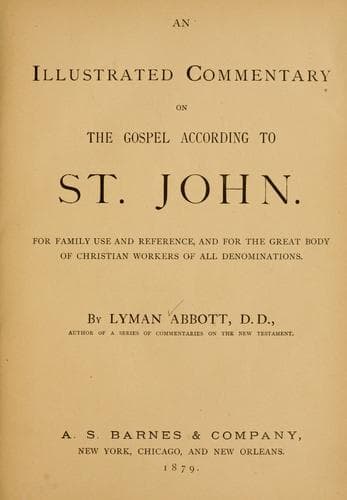
An illustrated commentary on the Gospel according to St. JohnAbbott, Lyman
Religion
An illustrated commentary on the Gospel according to St. John
Abbott, Lyman
Bible. John -- Commentaries
In respect to this miracle, observe, (1) _The simplicity of the
narrative_. John does not directly assert that the water was made wine,
nor that a miracle was performed, nor does he deduce any conclusion
from the event; he simply narrates what he saw and heard--the jars
filled with water, the contents drawn out, the testimony of the
governor of the feast to the excellence of the wine carried to
him; the reader is left to draw his own conclusion. (2) _The utter
failure of all naturalistic explanations_, such as that Christ simply
accelerated the process of nature, or changed the attributes of the
water after the analogy of mineral waters, so as to give it the taste
and appearance of wine, or that the taste and semblance of wine was
due to a state of spiritual exaltation on the part of the company, all
of which views have had defenders even among orthodox critics. See
Lange’s and Meyer’s Commentaries for a statement of these and kindred
interpretations. Meyer well says, respecting them all, “Instead of a
transmutation of water we have a frivolous transmutation of history.”
(3) _The impossibility of deception or fraud._ The jars are those
belonging to the household; they are filled to the brim with water;
it is drawn out by the servants; the judgment respecting the wine is
pronounced by the governor of the feast, who does not know of the
miracle. (4) _The analogy of nature._ “He who made the wine at this
wedding does the same thing every year in the vines. As the water
which the servants put into the water-pots was turned into wine by
the Lord, so that which the clouds pour down is turned into wine by
the same Lord. It excites no wonder in us, because it occurs every
year.”--(_Augustine._) (5) _The moral and spiritual significance of
the miracle._ Contrast Christ’s ready consent to convert water into
wine to add to the festivities of others, with his refusal to convert
stones into bread to supply his own imperative needs (Matt. 4:3, 4);
his conversion of water into wine, the symbol of inspiration and life,
with the first miracle of Moses, who converted water into blood, an
instrument and a symbol of death (Exod. 7:20, 21)--Christ brings life
and power, Moses brings law and condemnation (Rom. 7:8, 9); his
entrance on his ministry by attendance on a marriage festivity, and
his miracle to prolong its festivities, with the asceticism of John
the Baptist (Luke 1:15; Matt. 3:4). Compare his inauguration of the
new covenant by a miracle at a marriage with God’s inauguration of the
old covenant by ordaining and creating the marriage relation (Gen.
1:21-24). Notice in this miracle a type of Christ’s redeeming love,
who converts the water of the law into the wine of the Gospel, and
every soul which hears and obeys his creative command into an
inspiring life-giving spirit (John 5:21; 6:33; 1 Cor. 15:45). Observe
the fundamental lesson, that Christ’s example bids us not to withdraw
from the world, nor abstain from its use, but to use without abusing
Public-domain text, read in full here on John Shaqi.
Reviews
Reviews
No reviews yet
Be the first to share your thoughts on this work.
Elsewhere in the archive
Join the Discussion
Join the discussion
Sign in to leave a comment or review.
Sign InorCreate an account