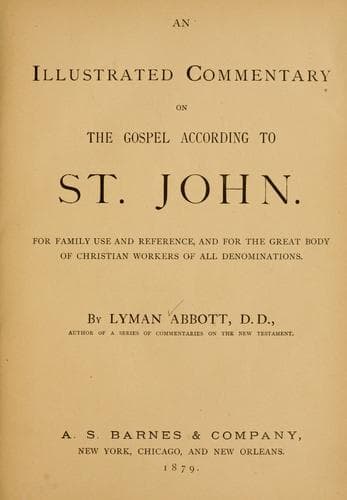
An illustrated commentary on the Gospel according to St. JohnAbbott, Lyman
Religion
An illustrated commentary on the Gospel according to St. John
Abbott, Lyman
Bible. John -- Commentaries
prohibition the sole object of which was to remind the Jews of the
haste of the original passover. Paul’s language in 1 Cor. 11:21 (see
note there) makes it evident that fermented wine was used by the
primitive church in the administration of the Lord’s Supper; and the
Rabbinical rule, requiring water to be mixed with the wine at the
paschal feast (see Lightfoot on Matt. 26:27), lest drunkenness should
disgrace it, makes it equally evident that wine was used in the
original O. T. festival. There is nothing in the language of the N. T.
to indicate any discrimination between fermented and unfermented
wines; Christ himself never directly or indirectly discriminates
between them; neither do any of his apostles; and it is apparently
indicated if not necessarily implied in the account here, and in other
passages, that it was the ordinary fermented wine which Christ
employed; see especially Matt. 11:19, “Behold a glutton and a
wine-bibber,” and Matt. 9:17, “No man having drunk old (_fermented_)
wine, straightway desireth new (_that of the last vintage and
unfermented_), for he saith the old is better.” The language of Mark
14:25, “I will drink no more of the fruit of the vine,” etc., plainly
implies that he had been accustomed to drink it freely and as a
beverage with his followers. I judge then that Christ here made, and
throughout his life ordinarily used, fermented wine; and this is the
nearly unanimous judgment of the best unprejudiced Biblical scholars.
The opposite opinion is of later origin, an after-thought, the product
not of impartial Biblical research, but of the temperance reformation.
(2) _Significance of these facts._ It appears to me clear, in the
light of these facts, that neither Christ’s precept nor his example
can be cited in favor of the doctrine of total abstinence, as a
universal and permanent obligation from all use of wine, even as a
beverage; that it rather indicates that he recognizes the right and
propriety of so using it; and that the doctrine and practice of total
abstinence must be maintained, if at all, not by any specific precept,
nor by the general course of Christ’s life, but from local and perhaps
temporary considerations, and solely on the ground that the Christian
must always be willing to surrender a lawful gratification for the
sake of a higher good, either to himself or to others (Matt. 5:29, 30;
Rom. 14:21; 1 Cor. 6:12). It is equally clear that neither Christ’s
precepts nor his example justifies the ordinary drinking usages of
American society of to-day, with its bars, its wine-shops, its
beer-gardens, its fiery wines and strong liquors, and all its
attendant evils. The ordinary wine of to-day is a very different
article from that in Christ’s day. The _word_ is the same, the _thing_
is different. And the usages are equally different. It is not my
province here to enter into a general discussion of the temperance
question, or even of the Bible teaching on the subject; but for the
Public-domain text, read in full here on John Shaqi.
Reviews
Reviews
No reviews yet
Be the first to share your thoughts on this work.
Elsewhere in the archive
Join the Discussion
Join the discussion
Sign in to leave a comment or review.
Sign InorCreate an account