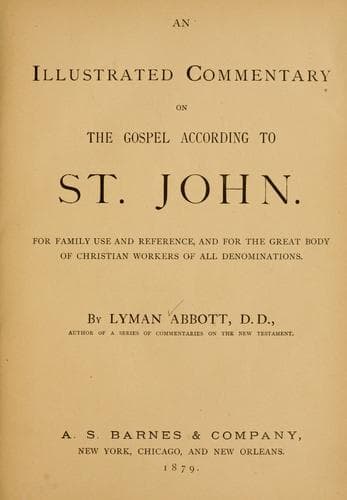
An illustrated commentary on the Gospel according to St. JohnAbbott, Lyman
Religion
An illustrated commentary on the Gospel according to St. John
Abbott, Lyman
Bible. John -- Commentaries
it (1 Cor. 7:31), and that the assertion that Christianity bids men
“make this earth as unpleasant to themselves as possible so as to
secure hereafter the joys of heaven,” is a monstrous perversion of the
teaching and example of Jesus Christ. Comp. Matt. 9:9, 10; 11:19; Luke
7:36; 11:37; 14:1; John 12:1, 2.
* * * * *
CHRIST’S EXAMPLE IN THE USE OF WINE. 1. _The facts._ These are that
Christ inaugurated his public ministry by attending a wedding feast,
and there by a miracle creating a large quantity of wine--certainly
all that the guests could use--for the simple purpose of prolonging
the festivities of the occasion; that he was accustomed throughout his
life to attend social gatherings where wine was freely used; that he
used it freely himself, notwithstanding the fact that it subjected him
to the reproaches and the misrepresentations of his enemies (Matt.
11:19; Luke 7:34); that he never directly or indirectly condemns the
use of wine, though he does condemn drunkenness (Matt. 24:49; Luke
12:45); and that he directs its use by his church as a perpetual
memorial of his atoning love, and employs it as a symbol of joy and
fellowship in the world to come (Matt. 26:26-29; Mark 14:22-25; Luke
22:18; 1 Cor. 10:16). The force of this example is strengthened by the
reflection that drunkenness was common in the East before Christ’s day
(Esther 1:10; Isa. 5:22; 28:7; Dan. 5:2-4; Hosea 4:11), and in
Palestine and the neighboring countries during Christ’s lifetime, so
that even the church of Christ had need of constant admonition against
it (Matt. 24:49; Luke 15:13; Rom. 13:13; 1 Cor. 11:21; Gal. 5:21; 1
Pet. 4:3); that a Jewish Sect existed, the Essenes (Matt. 3:7, note),
who were total abstainers, with whom Christ never identified himself;
and that he directly contrasts his life and example with that of John
the Baptist (Matt. 11:19), who, as a Nazarite, was pledged against the
use of wine and strong drink (Luke 1:15; Numb. 6:3). Attempts have
been made to show that the wine which Christ made on this occasion and
used on other occasions was not fermented. It is certain that there
were in use in the Greek and Roman world, and presumptively in
Palestine, three kinds of wine--fermented wines, which, however, were
unlike our own fiery wines and contained only a small percentage of
alcohol, and which were usually mixed in the use with water, in the
proportion of two or three parts of water to one of wine; new wine,
made of the juice of the grape, and, like our new cider, not fermented
and not intoxicating; and wines in which, by boiling the unfermented
juice of the grape, or by the addition of certain drugs, the process
of fermentation had been stopped, and the formation of alcohol
prevented. It is claimed that fermented wine was not used at the
Passover, though I can find no other reason for this opinion than the
fact that leavened, _i. e._, fermented bread was prohibited--a
Public-domain text, read in full here on John Shaqi.
Reviews
Reviews
No reviews yet
Be the first to share your thoughts on this work.
Elsewhere in the archive
Join the Discussion
Join the discussion
Sign in to leave a comment or review.
Sign InorCreate an account