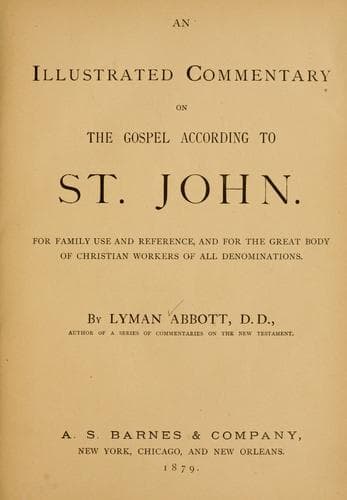
An illustrated commentary on the Gospel according to St. JohnAbbott, Lyman
Religion
An illustrated commentary on the Gospel according to St. John
Abbott, Lyman
Bible. John -- Commentaries
This and the subsequent purification of the temple during the Passion
week, indicate in Christ a vigor and intensity of character, and a
power of indignation, which modern thought rarely attributes to him.
They interpret the suggestive description of Christ’s personal
appearance given by John in Rev. 1:13-16, the only hint of his
personal appearance afforded by the New Testament. We can imagine that
in this expulsion his eyes were as flames of fire, his feet firm in
their tread like feet of brass, his voice as the sound of the ocean,
his words as a two-edged sword. This indignation was aroused by (_a_)
the sacrilegious covetousness which made God’s house a house of
merchandise; (_b_) the fraud which converted it into a den of thieves;
(_c_) the selfishness of the bigotry which excluded the heathen from
the only court reserved for them. It should inspire in his disciples a
like spirit of indignation (_a_) against the sacrilegious covetousness
which converts the house of God into a mart of merchandise, whether by
the sale of indulgences, masses, and prayers to others, or by
employing it not for the praise of God but for the social and
pecuniary profit of the pretended worshipper; (_b_) against the
bigotry which permits us to look with indifference upon the exclusion
of the poor, the outcast, the despised from the privileges of God’s
house. It is a type of (_a_) the cleansing which Christ comes to do
for every soul, which is a temple of God (1 Cor. 3:16), and out of
which all unclean things must be driven by the power of God, before it
is fit for God’s indwelling; (_b_) the final cleansing when he will
come to cast out all things that defile and work abomination (Rev.
21:27). Observe that in Revelation the world is represented as
dreading “the wrath of _the Lamb_.” Christ’s example here does not
justify the use of physical force by the church to cleanse it from
corruption; for Christ did not employ physical force. His whip was not
a weapon; the power before which the traders fled was the moral power
of Christ, strengthened by the concurring judgment of their own
consciences and the moral sense of the mass of the people (Mark 11:15,
note).
18 Then answered the Jews and said unto him, What sign[80]
showest thou unto us, seeing that thou doest these things?
[80] ch. 6:30; Matt. 12:38, etc.
19 Jesus answered and said unto them, Destroy[81] this
temple, and in three days I will raise it up.
[81] Matt. 26:61; 27:40.
Public-domain text, read in full here on John Shaqi.
Reviews
Reviews
No reviews yet
Be the first to share your thoughts on this work.
Elsewhere in the archive
Join the Discussion
Join the discussion
Sign in to leave a comment or review.
Sign InorCreate an account