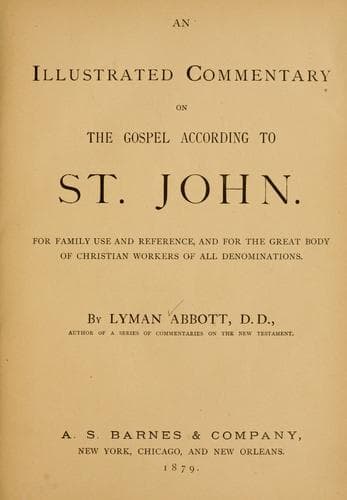
An illustrated commentary on the Gospel according to St. JohnAbbott, Lyman
Religion
An illustrated commentary on the Gospel according to St. John
Abbott, Lyman
Bible. John -- Commentaries
=18, 19. What sign showest thou unto us?= What evidence of authority
to expel from the temple practices allowed by the priesthood. They
questioned not the right of an inspired prophet to act thus, but the
authority of Jesus as a prophet. The moral power before which all
quailed was the greatest of signs; but to that they were indifferent.
“They required signs to be proved by signs.”--(_Bengel._) No other
authority for any reformation is ever required than the power
and grace to achieve it. The same question was repeated at the
second cleansing, but it elicited a very different answer (Matt.
21:23).--=Destroy this temple and in three days I will raise it up.=
In interpreting this passage observe that (1) John himself explicitly
declares Christ’s meaning, “He spake of the temple of his body” (ver.
21); (2) that not only the Jews, who might have willfully perverted
Christ, misunderstood his meaning, but his own followers did not, till
after his death, understand him (ver. 22); hence (3) the hypothesis
that he pointed to himself when he said, “Destroy this temple,” is not
only unnecessary but improbable. The words are a prophecy, but are
purposely left enigmatical, to be interpreted by the event. The temple
is itself a type of man, who is intended to be the temple of God, in
which he will dwell; and therefore a type perfectly fulfilled only in
Christ, in whom alone the Spirit of God dwelt without measure, and
with no periods of partial or complete exclusion. The Jews in
crucifying Christ destroyed the divine reality of which the building
was only a symbol or prophecy; moreover they inaugurated that terrible
drama of passion which ended in the literal destruction of the temple
itself. For description of this destruction see Matt. ch. 24, Prel.
Note. Some objections to this passage have been suggested. (1) _The
crucifixion of Christ and his resurrection taking place three years
later cannot be a sign of his authority here._ Ans. In fact Christ
does not comply with the Pharisees’ demand for a sign but refuses it,
as in the analogous passage in Matt. 12:34-40, where he also by a
metaphor refers to his resurrection. (2) _The prophecy would not be
and in fact was not understood._ Ans. It was not intended to be
understood then, but to afford a basis for the faith of the disciples
when subsequent history had interpreted it. It was an enigma more
likely to be remembered because enigmatical. “Many such sayings he
uttered which were not intelligible to his immediate hearers, but
which were to be so to those who should come after. And wherefore doth
he do this? In order that when the accomplishment of his predictions
should have come to pass, he might be seen to have foreknown from the
beginning what was to follow.”--(_Chrysostom._) (3) _The language is
imperative and thus involves a command by Christ to crucify him._ Ans.
The imperative, _Destroy this temple_, is not equivalent to the
future, You will destroy this temple; nor is it permissive merely, You
Public-domain text, read in full here on John Shaqi.
Reviews
Reviews
No reviews yet
Be the first to share your thoughts on this work.
Elsewhere in the archive
Join the Discussion
Join the discussion
Sign in to leave a comment or review.
Sign InorCreate an account